You’re a Swiss resident sitting on 500,000 francs from a parental gift, watching the S&P 500 climb to historic valuations while your mortgage renews at 2.1%. Your banker pitches a rental property that “pays for itself”, but you’re haunted by a nagging question: has the world’s most reliable wealth-building engine finally become too expensive to trust? This isn’t just another market timing debate, it’s a uniquely Swiss calculation where currency hedging costs, negative-yielding bonds, and the specter of Eigenmietwert reform collide with American equity euphoria.
The Valuation Problem Staring Swiss Investors in the Face
The numbers don’t just look stretched, they look historically unprecedented. The Shiller S&P 500 Price-to-Earnings ratio hit 40.74 in late December, its second-highest level since 1871. The average? A sober 17. The Buffett Indicator, measuring total market cap against GDP, flashes similar warnings. For a Swiss investor whose home currency has strengthened relentlessly, these aren’t abstract metrics, they’re potential double jeopardy.
Consider the currency dimension. One Swiss investor reported that the 13% loss on USD/CHF exchange rates more than wiped out the 4% coupon on ten-year Treasuries this year. After hedging costs, that juicy 4.1% Treasury yield shrivels to a meager 0.35%, barely above Swiss government bonds paying 0.27%. Suddenly, the “risk-free” rate differential that justifies US equity exposure evaporates.
When Your Banker Becomes a Bear
The skepticism runs deeper than valuation metrics. Behind closed doors at Swiss banks, advisors are quietly questioning the orthodoxy. One Genève-based private banker confessed that clients inheriting substantial sums now face a genuine dilemma: pour everything into an overvalued US market, or lock capital into Swiss real estate with its own set of risks.
The Reddit thread from r/SwissPersonalFinance captured this tension perfectly. A user receiving 500,000 CHF from a parental home sale wondered whether to buy a rental property or invest in markets. The top response suggested splitting the difference, 250,000 CHF toward a rental, 250,000 CHF in stocks. But even this “Swiss neutrality” approach drew criticism: where exactly do you find a 625,000 CHF studio apartment with “good yield” in today’s market?
The math reveals the challenge. One commenter detailed two studio apartments purchased for 228,000 CHF each, rented for 1,180 CHF monthly with 140 CHF community charges. After a 50% down payment and 1.47% fixed financing, the returns look attractive, until you factor in maintenance, vacancy risk, and the looming abolition of Eigenmietwert that could reshape the entire Swiss property investment calculus.
The Contrarian Roar from Romandie
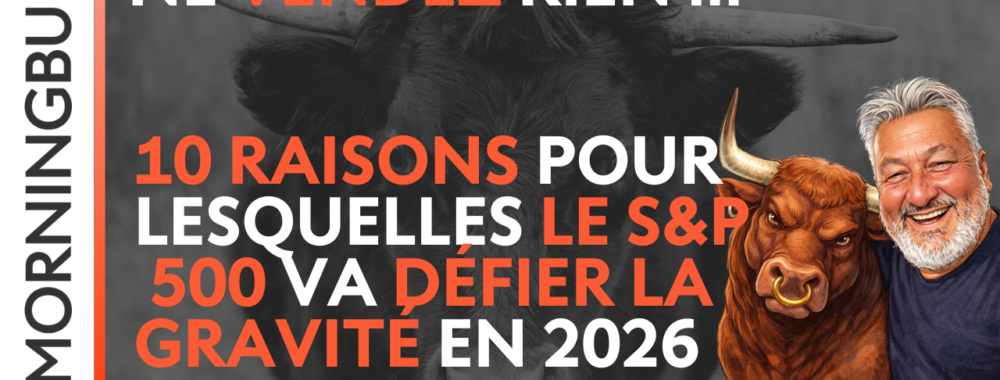
While anglophone analysts wring their hands, French-speaking Switzerland offers a defiant counter-narrative. Investir.ch recently published a provocative piece titled “Ne vendez RIEN ! 10 raisons pour lesquelles le S&P 500 va défier la gravité en 2026”, essentially “Don’t Sell! 10 Reasons the S&P 500 Will Defy Gravity.” The argument isn’t magical thinking but cold mechanics: massive tax cuts, aggressive deregulation, and record-breaking share buybacks form a potent cocktail.
The article dismisses bears as perpetually waiting for a crash that never arrives. While they predict apocalypse, the market “prepares a vertical explosion for 2026.” This isn’t just financial journalism, it’s a reflection of how deeply US equity culture has penetrated Swiss investment thinking, even in the traditionally more cautious Romandie region.
The Hedging Cost Reality Check
What the bullish narrative conveniently ignores is the Swiss franc problem. TheMarket.ch analysis reveals the brutal math: hedging a 4.1% Treasury yield costs approximately 3.75%, leaving virtually nothing. For direct equity exposure, the picture isn’t much better. Currency hedging for S&P 500 ETFs typically costs 0.3-0.5% annually, a persistent drag that compounds over time.
More sophisticated Swiss investors are exploring alternatives. Some are tilting toward the Swiss Market Index, which offers a 2.9% dividend yield, higher than the DAX and with less currency risk. Others are eyeing European equities, where valuations remain more reasonable and the euro exposure provides natural diversification against dollar concentration.
Real Estate: The Devil You Know
The Swiss property market presents its own complexities. With Eigenmietwert potentially facing abolition, the tax advantages of homeownership could shift dramatically. Yet rental yields in secondary cities remain attractive compared to negative-yielding bonds.
The half-property, half-stocks strategy gaining traction in Swiss forums makes behavioral sense, if not pure financial optimization. It acknowledges that for many Swiss investors, the psychological comfort of local bricks-and-mortar offsets the mathematical elegance of global equity diversification. One Zurich-based advisor noted that clients who split inheritances this way sleep better, even if their Sharpe ratio suffers marginally.
The Diversification Illusion
Here’s where the debate gets philosophically interesting. Die-hard index investors argue that a global ETF like VT is true diversification, thousands of companies across dozens of countries. Skeptics counter that market-cap weighting creates dangerous concentration: the top 10 S&P 500 holdings now represent over 30% of the index, and the US market overall dominates global benchmarks.
The Swiss investor’s dilemma exposes this tension. Is putting 250,000 CHF into a Zurich studio and 250,000 CHF into VT truly diversified, or is it just two different forms of concentrated risk? The property depends on local zoning laws and immigration patterns, the ETF depends on American monetary policy and tech monopolies.
Practical Positioning for 2026
So what’s a prudent Swiss investor to do with that 500,000 CHF windfall?
First, quantify your currency risk. If you’re earning in CHF and planning retirement in Switzerland, heavy USD exposure creates genuine vulnerability. The 13% currency loss in 2025 wasn’t a fluke, it was the third significant CHF strengthening cycle in fifteen years.
Second, calculate true hedging costs. Don’t rely on simplified yield comparisons. A 0.35% net yield from hedged US bonds doesn’t compensate for the risk compared to 0.27% from Swiss bonds when you factor in peace of mind.
Third, reconsider what “diversification” means for your situation. For some, that means Swiss real estate plus global equities. For others, it might mean European equities plus gold. TheMarket.ch analysts note that commodity producers and basic consumer goods, widely unloved sectors, now trade at valuations that genuinely diversify risk rather than just tracking the same growth narrative.
Fourth, stay alert but not paralyzed. As Seeking Alpha’s outlook suggests, sectoral undervaluation pockets exist even in an expensive market. Healthcare, utilities, and select commodities trade at reasonable multiples. Swiss investors have home-field advantage in pharma through Roche and Novartis, both trading at discounts to US peers.
The Verdict: Skepticism as Strategy
The smartest Swiss investors aren’t abandoning the S&P 500, they’re approaching it with the same skepticism they apply to everything else. They’re questioning whether 40x cyclically-adjusted earnings represent a new normal or a statistical outlier waiting to revert. They’re calculating whether currency hedging costs negate the equity risk premium. And they’re recognizing that in a world of financial repression, sometimes the best choice is the least bad option.
For that 500,000 CHF inheritance, consider a barbell: maximum 40% in unhedged global equities through your Swissquote account, 30% in Swiss property (if you understand local market dynamics), and 30% in short-term CHF bonds or a PostFinance savings account yielding next to nothing but preserving option value. It’s not elegant, but it reflects a Swiss reality where caution isn’t just cultural, it’s mathematical.
The S&P 500’s growth narrative isn’t dead. But for Swiss investors, the days of blindly plowing francs into US markets are over. Alpine prudence demands nothing less.

As 2026 approaches, Swiss investors face a fundamental question: has the S&P 500’s reliability become a luxury good priced beyond its utility?