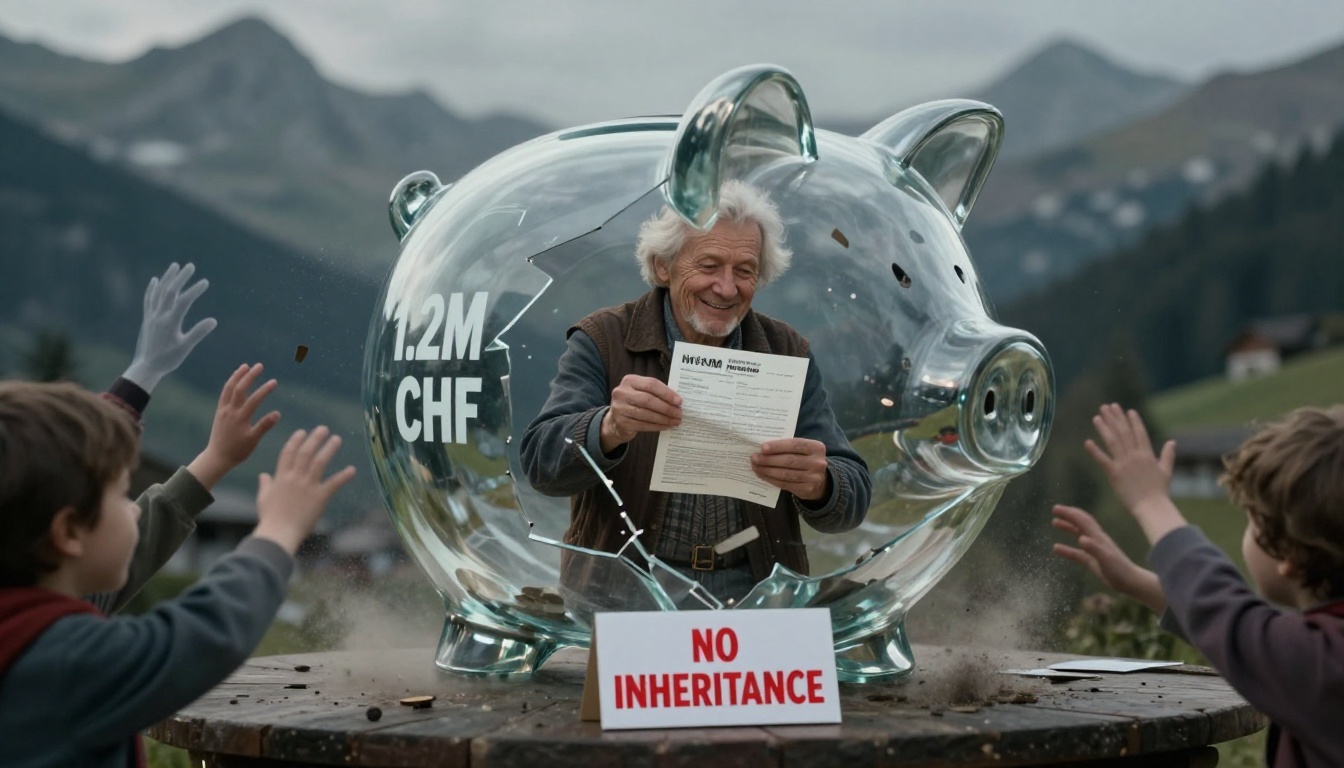
Your Pensionskasse (pension fund) statement shows a healthy six-figure balance. You’ve spent decades building this nest egg, comforted by the thought that even if you don’t need it all, your children will inherit the remainder. This is Switzerland, after all, land of financial prudence and intergenerational wealth. But that comfort evaporates the moment you tick the “annuity” box at retirement. Your pot doesn’t just shrink, it disappears entirely, legally and permanently, leaving your heirs with nothing from that portion of your life’s savings.
The Disappearing Act: How Pillar 2 Erases Your Wealth
The mechanism is brutally simple. When you reach retirement age, you face a binary choice for your Pillar 2 assets: take the entire amount as a lump sum (subject to a one-time tax at reduced rates) or convert it into a lifetime annuity. Choose the annuity, and the conversion rate determines your annual income, currently around 4.7% if you retire at 64, or 4.2% at 60. A 1.2 million CHF pot becomes 56,400 CHF per year for life.
What the brochure doesn’t emphasize is the finality of this transaction. The capital is gone. Not “partially depleted” or “gradually drawn down”, gone. If you live exactly 21 years after retiring at 64, you break even. Die earlier, and the Pensionskasse keeps the surplus. Live longer, and you continue receiving payments funded by other people’s forfeited capital. The system functions as a collective longevity insurance pool, which is precisely why it cannot accommodate inheritance.
Many international residents report shock when they first understand this. The prevailing sentiment among expats is that Switzerland’s reputation for financial security masks a system that prioritizes collective risk pooling over individual wealth preservation. One high-earning professional discovered that their projected 1.2 million CHF Pillar 2 balance would vanish upon annuitization, despite having additional assets including a spouse’s public sector pension, maxed-out 3a accounts, property, and private investments. The question they posed, why not take the lump sum and invest it, reveals the core tension in Swiss retirement planning.

The High Earner’s Disadvantage: When Extra-Mandatory Becomes Extra-Punitive
The conversion rate trap deepens for those earning over approximately 100,000 CHF annually. The mandatory portion of your Pillar 2 (up to the BVG coordination deduction) must legally use a conversion rate of 6.8%. But your extra-mandatory contributions, often the lion’s share for high earners, can legally use much lower rates. Some pension funds apply rates as low as 4.5% or even 4.2% on this portion.
This creates a perverse outcome: the more you’ve contributed beyond the mandatory minimum, the worse the annuity deal becomes. A 200,000 CHF salary might mean 80% of your Pillar 2 pot falls under these reduced rates. Your effective blended conversion rate could be 5.2% instead of 6.8%, making the lump sum option mathematically superior for anyone with decent investment discipline.
The ASIP (Swiss Pension Fund Association) recently rejected proposals to flatten contribution rates and start saving earlier, arguing that such changes would disadvantage those already deep in their careers. This institutional resistance to reform means the inheritance problem persists for the foreseeable future.
The Math That Destroys Legacy Plans
Let’s run the numbers without sentiment. At a 4.7% conversion rate, your capital lasts exactly 21.3 years. Retire at 64, and you break even at 85.3 years old. Swiss life expectancy for men is 81.7, for women 85.4. Statistically, men lose this bet, women roughly break even.
But the 4% withdrawal rule, popular in FIRE communities, assumes market exposure and capital preservation. A 1.2 million CHF lump sum, even earning just 2% above inflation, would sustain 56,400 CHF annual withdrawals for 30 years while leaving 400,000 CHF intact for heirs. That’s the difference between a legacy and a receipt for zero.
The counterargument is risk. Markets crash. Cognitive decline happens. A 70-year-old managing investments during a downturn faces stress that could be avoided with a guaranteed annuity. This is valid. But it’s an insurance premium paid not in cash, but in forfeited inheritance. For those with substantial other assets, property, 3a accounts, private pensions, the annuity’s security is often redundant.
Tax Traps: Cantonal Differences That Double Your Cost
Here’s where the Swiss system reveals its complexity. Lump sum withdrawals face a one-time tax at reduced rates, but these rates vary wildly by canton. Zurich might tax your 1.2 million CHF payout at 8%, while Bern takes 15%. That’s a 84,000 CHF difference, enough to fund several years of retirement.
Annuity payments, by contrast, are taxed as regular income each year. For high earners with other income sources, this can push them into higher brackets. The tax-optimal choice depends on your canton of residence, total asset picture, and life expectancy. Many expats report discovering these differences only after making irreversible decisions.
The risks and trade-offs of maximizing Pillar 2 contributions compound this problem. Over-contributing early in your career locks capital into a system with limited flexibility and zero inheritance value if annuitized.
The Pillar 3a Advantage: Capital That Counts for Heirs
Pillar 3a operates under fundamentally different rules. It pays out exclusively as capital, no annuity option exists. This makes it the Swiss retirement vehicle of choice for inheritance planning. The new 2026 rules allowing back-payments for up to ten years amplify this advantage.
You can now fill gaps in your 3a contributions retroactively, up to 7,258 CHF per year. While this doesn’t change the annual maximum, it allows strategic timing. If you anticipate a high-income year, you can reduce your tax burden by making multiple years’ worth of contributions. More importantly, this capital remains yours to invest and bequeath.
The trade-off? 3a accounts lack the longevity insurance of Pillar 2. But for those with sufficient assets to self-insure, this is a feature, not a bug. The capital remains in your estate, available for heirs, charitable giving, or emergency use.
Strategic Workarounds: Preserving Wealth Within the System
Given these constraints, what’s the inheritance-conscious strategy?
- First, scrutinize your Pensionskasse’s conversion rates. Request your Vorsorgeausweis (pension statement) and calculate the blended rate. If it’s below 5.5% and you have other assets, the lump sum likely wins.
- Second, consider partial annuitization. Some funds allow splitting your pot, annuitizing just enough to cover essential living expenses, taking the rest as capital. This hybrid approach provides security while preserving wealth.
- Third, prioritize 3a contributions over voluntary Pillar 2 buybacks. The latter locks capital into the inheritance-void annuity system, while 3a builds transferable wealth.
- Fourth, plan your property strategy carefully. The inheritance and succession planning around real estate and family wealth becomes critical when your pension pot can’t help heirs with a mortgage. A paid-off property might be the only substantial asset they receive.
- Fifth, maintain liquid investments outside the pension system entirely. While you lose tax deductions, you gain complete control and full inheritance rights. The digital asset access and inheritance planning for investment accounts article highlights how even these require careful planning to ensure your spouse can access them.
The Cultural Disconnect: Why Swiss Residents Accept This
Swiss culture prioritizes collective security over individual legacy. The Pillar 2 system reflects social solidarity, you’re not just saving for yourself, but participating in a pool that protects everyone from longevity risk. This explains why inheritance concerns rarely drive policy debates.
Expats from countries where retirement accounts are inheritable (UK SIPPs, US IRAs) find this cultural gap jarring. The expectation that children should build their own wealth, not inherit yours, is deeply embedded. But international residents often have different family obligations, supporting aging parents abroad, funding cross-border education, or simply maintaining family wealth across generations.
The wealth preservation strategies involving real estate vs. liquid investments become more pressing when your pension can’t serve as a safety net for heirs.
When the Lump Sum Makes Sense: A Decision Framework
Choose the lump sum if:
– Your blended conversion rate is below 5.5%
– You have substantial other assets (property, 3a, private pensions)
– Your health or family history suggests below-average longevity
– You have investment experience and emotional discipline
– Inheritance is a priority, not just a bonus
– Your canton taxes lump sums favorably
Choose the annuity if:
– The conversion rate exceeds 6% on your mandatory portion
– You lack investment experience or fear cognitive decline
– You have no other guaranteed income sources
– You value longevity insurance above all else
– Your canton taxes income more favorably than capital
The 4% withdrawal rule works mathematically but requires discipline. Market volatility at 75 feels different than at 45. Yet even ultra-conservative strategies, 30-year Swiss government bonds yielding 0.45%, outperform annuities for inheritance purposes. At 4.7% withdrawal, your capital lasts 26 years even with zero returns. With bonds, it extends to 28.5 years. The “risk” is often overstated for those with diversified assets.
The Bottom Line: Design Your Own Safety Net
Switzerland’s Pillar 2 system is not designed for inheritance. It’s designed to prevent elderly poverty. Treat it as such. Maximize your 3a contributions, maintain external investments, and view the Pillar 2 lump sum as a windfall to be preserved, not an annuity to be optimized.
For high earners, the math is clear: taking the lump sum and investing conservatively beats annuitization while preserving capital for heirs. The security argument holds weight only for those without other assets. Everyone else pays an enormous premium for psychological comfort.
Before making this irreversible choice, request detailed projections from your Pensionskasse. Calculate the break-even age. Assess your other assets honestly. And remember: in Switzerland, the system protects you from destitution, but it’s your job to protect your family’s inheritance.