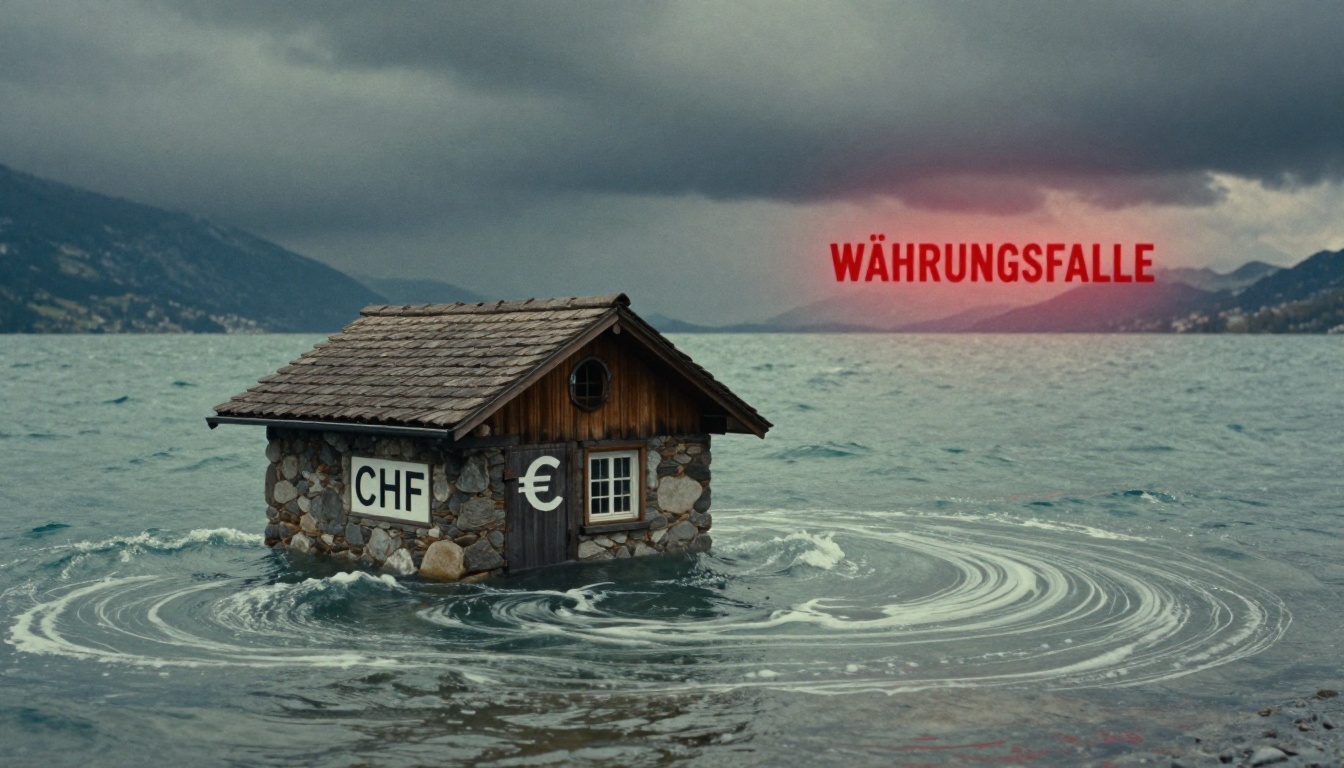
You’re earning a solid Swiss salary in Bern, dreaming of that €185,000 apartment in Marbella. The bank offers you a tempting CHF mortgage at SARON +2.10%, sounds cheaper than those EUR rates around 4%. Your spreadsheet shows neutral cashflow, and the banker assures you it’s “prudent.” Here’s what they conveniently forget to mention: you’re building a financial time bomb that could blow up your retirement plans faster than you can say Währungsrisiko (currency risk).
The math feels simple. You earn in CHF, convert to EUR for the down payment, then let rental income cover the mortgage. But this comfortable illusion ignores a fundamental rule that experienced cross-border investors learn the hard way: never borrow in a different currency than your asset generates income. When your Spanish flat produces EUR rent but your debt is in CHF, you’re not an investor, you’re a currency speculator, and the house always wins.
The Real Cost of Currency Mismatch
Let’s run the actual numbers from our Marbella example. With 60% LTV, you’re borrowing €111,000 in CHF terms. At today’s rate around 0.92 EUR/CHF, that’s roughly CHF 120,652. Your monthly payment at SARON +2.10% might look manageable at first. But UBS forecasts EUR/CHF climbing to 0.95 within 12 months, and if Eurozone growth surprises to the upside, that pair could test parity again.
If the franc weakens to 0.95, your €111,000 debt suddenly costs you CHF 116,842, CHF 3,810 more overnight. At 1.00, you’re looking at CHF 111,000 versus your original CHF 120,652 budget. But here’s the kicker: your rental income is still €800 monthly, fixed in euros. While your debt balloons in franc terms, your income stream shrinks relative to it. That “neutral” cashflow? It turns deeply negative, and your bank won’t send you a sympathy card.
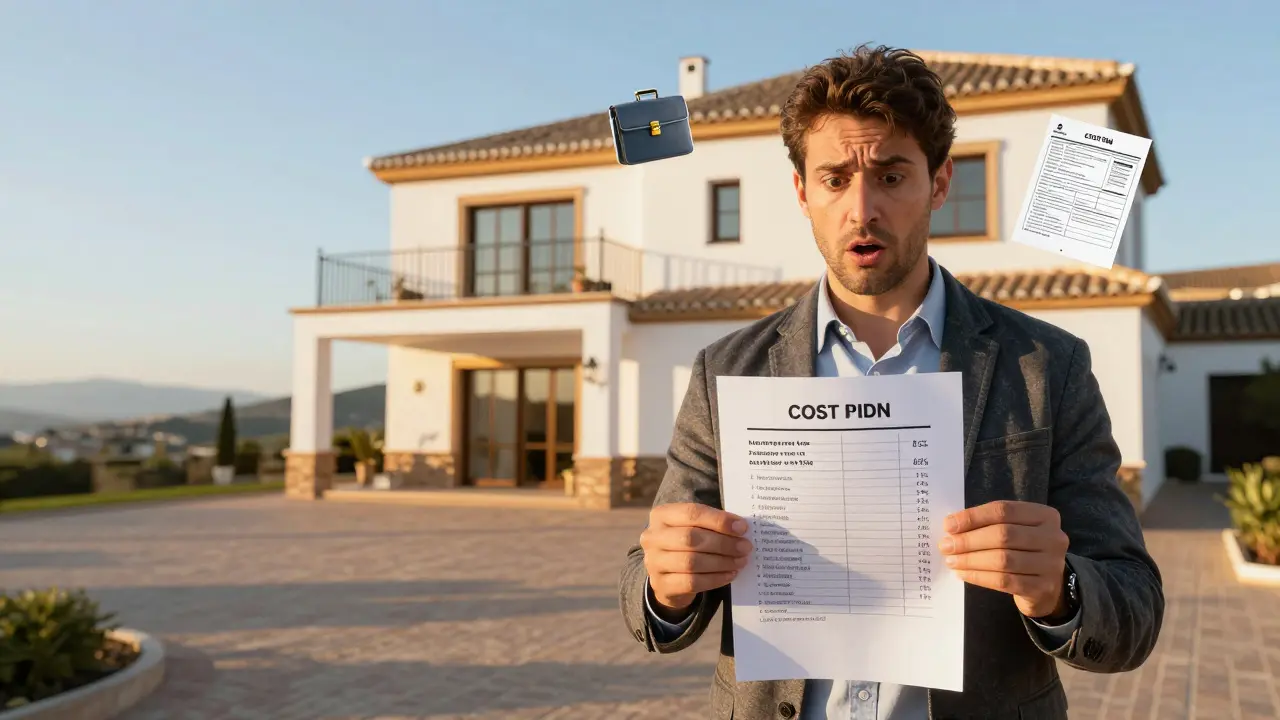
The Kaufnebenkosten (purchase costs) comparison above shows Spain hitting 12-15% of property value, already a painful €22,000-€28,000 on your €185,000 purchase. Germany lands around 10-13%, while Austria looks almost reasonable at 5-7%. But these percentages mask the currency risk: if you’re converting CHF savings for that 40% down payment, a 5% swing in EUR/CHF costs you an extra CHF 3,700 before you’ve even collected keys.
Why Swiss Banks Love Your CHF Mortgage
Swiss lenders aren’t offering CHF financing for your Spanish property out of generosity. They’re offloading risk directly onto you. When you sign that SARON-linked loan, you’re essentially giving them a free option: if the franc strengthens, they profit on your higher relative payments. If it weakens, you absorb every centime of loss while they collect their margin regardless.
The Reddit discussion reveals this clearly. One commenter bluntly warned: “if your asset is in EUR and your debt in CHF and potentially even your earnings, it can spell trouble with FX movements.” Another pointed out the tax inefficiency of this structure. Yet banks keep pushing these products because they understand something most buyers don’t: hidden currency conversion costs for Swiss investors can turn a “competitive” rate into a profit center for the lender.
Swiss mortgage rates have dropped to decade lows, ten-year fixes below 1.40% for qualified buyers. This makes domestic property financing attractive, but those conditions don’t translate to foreign assets. The strong franc and Swiss inflation at 0.1% create an environment where banks are desperate to deploy CHF, even into risky cross-border structures. Your Spanish rental becomes their high-yield playground, with you as the unpaid risk manager.
The Tax Trap Nobody Mentions
Here’s where it gets properly Swiss-complicated. As a Permit B holder, you’re currently under Quellensteuer (withholding tax) and don’t file returns. But foreign rental income changes everything. The moment you collect that first €800 from your Marbella tenant, you trigger mandatory tax filing in Switzerland. The income gets added to your Swiss earnings to determine your tax rate, even if you’ve already paid Spanish taxes on it.
The double taxation agreement between Switzerland and Spain means you won’t pay twice, but you will pay at Swiss rates if they’re higher. And that CHF mortgage interest deduction? It’s worth far less when you’re calculating Swiss tax on worldwide income. Suddenly your “tax-efficient” investment needs professional accounting help costing CHF 800-1,200 annually, another hidden cost that turns your neutral cashflow negative.
The EUR Mortgage: Your Only Real Option
Smart Swiss investors financing abroad follow one rule: match currency of debt to currency of income. The EUR mortgage rates around 4.1-4.8% look higher than CHF, but they’re honest. You know exactly what €800 rent covers in terms of €700 monthly payments. No surprises. No currency speculation. No praying to the FX gods.
The 70% LTV EUR mortgage at 4.1% fixed for 20 years gives you payment certainty. Yes, you need €70,000 down instead of €100,000, freeing up CHF 30,000 for other investments. More importantly, your debt shrinks exactly as your asset generates income. If EUR/CHF moves to 0.95, your €800 rent converts to CHF 842, more francs in your pocket, not less. The property becomes a genuine hedge rather than a liability.
Hedging Strategies for the Stubborn
If you’re absolutely set on that CHF mortgage (don’t say I didn’t warn you), at least implement proper hedging. Forward contracts can lock in exchange rates for 12-24 months, but they cost 2-3% annually and require active management. Currency options offer downside protection with upside potential, but the premiums eat into your already-thin margins.
A simpler approach: over-finance in CHF and immediately convert the loan amount to EUR via a multi-currency mortgage facility. Some Swiss banks offer these, allowing you to switch currencies periodically. But the conversion spreads are brutal, often 1-2% each way, and you still face the same fundamental mismatch when rates move against you.
The brutal truth? Most property investors lack the time and expertise to hedge effectively. You’re better off accepting the “higher” EUR rate as insurance against catastrophic loss. Think of that 1% premium as a policy that pays out when the franc decides to throw a tantrum.
When Relocation Plans Change Everything
Our Bern buyer plans to move to Spain in 5-10 years. This changes the calculation slightly. If you’ll eventually earn in EUR and live in EUR, a CHF mortgage creates a natural hedge later. But between now and then, you’re exposed. And Swiss banks know this, they’ll use your relocation plan to justify the CHF loan while quietly adding clauses that make currency switching expensive or impossible.
The smarter move? Start with EUR financing, then refinance into CHF after you’ve established Spanish tax residency and EUR income. The transition costs will be lower than five years of currency risk, and you’ll have actual income history to support the new loan structure.
The Opportunity Cost You’re Ignoring
Many Swiss buyers justify foreign property by pointing to Switzerland’s insane prices. A two-bedroom in Zurich’s outer districts commands CHF 1.2 million for a 70-square-meter box built in 1973, with gross rental yields around 2.8%. After Nebenkosten and mortgage payments, breaking even feels like victory. This makes Spanish yields of 5-6% look irresistible.
But the comparative investment potential of foreign vs. Swiss real estate reveals a different story. When you factor in currency risk, tax complexity, and management headaches, many Swiss investors discover they’ve traded a stable, low-yield asset for a high-risk, moderate-yield headache. The opportunity cost of holding cash in low-yield accounts at home might actually be lower than the hidden costs of cross-border property speculation.
Actionable Steps Before You Sign
-
Get three EUR mortgage quotes from Spanish banks specializing in non-resident lending. Compare the total cost over five years, not just the headline rate.
-
Model three FX scenarios: EUR/CHF at 0.92, 0.95, and 1.00. Calculate how each affects your CHF-denominated returns. If you can’t stomach the 1.00 scenario, walk away.
-
Talk to a Swiss tax advisor before purchasing. Understand exactly how foreign rental income impacts your Quellensteuer status and whether the investment still works under Swiss tax rules.
-
Budget 15% for Kaufnebenkosten in Spain, not the 10% your German friend promised. That means €27,750 in cash before you even start renovations.
-
Consider the liquidity premium. Swiss property sells in weeks. Spanish property can sit for months or years. That “great deal” in Marbella might become an anchor if you need cash quickly.
The bottom line? That CHF mortgage for your EUR rental property isn’t just risky, it’s a structural flaw in your investment thesis. The banks profit, the currency traders profit, and you absorb all the downside. Stick to EUR financing, accept the higher rate as insurance, and sleep soundly knowing your debt and income speak the same language. Your future self, checking exchange rates over morning coffee in Bern, will thank you for the sanity.