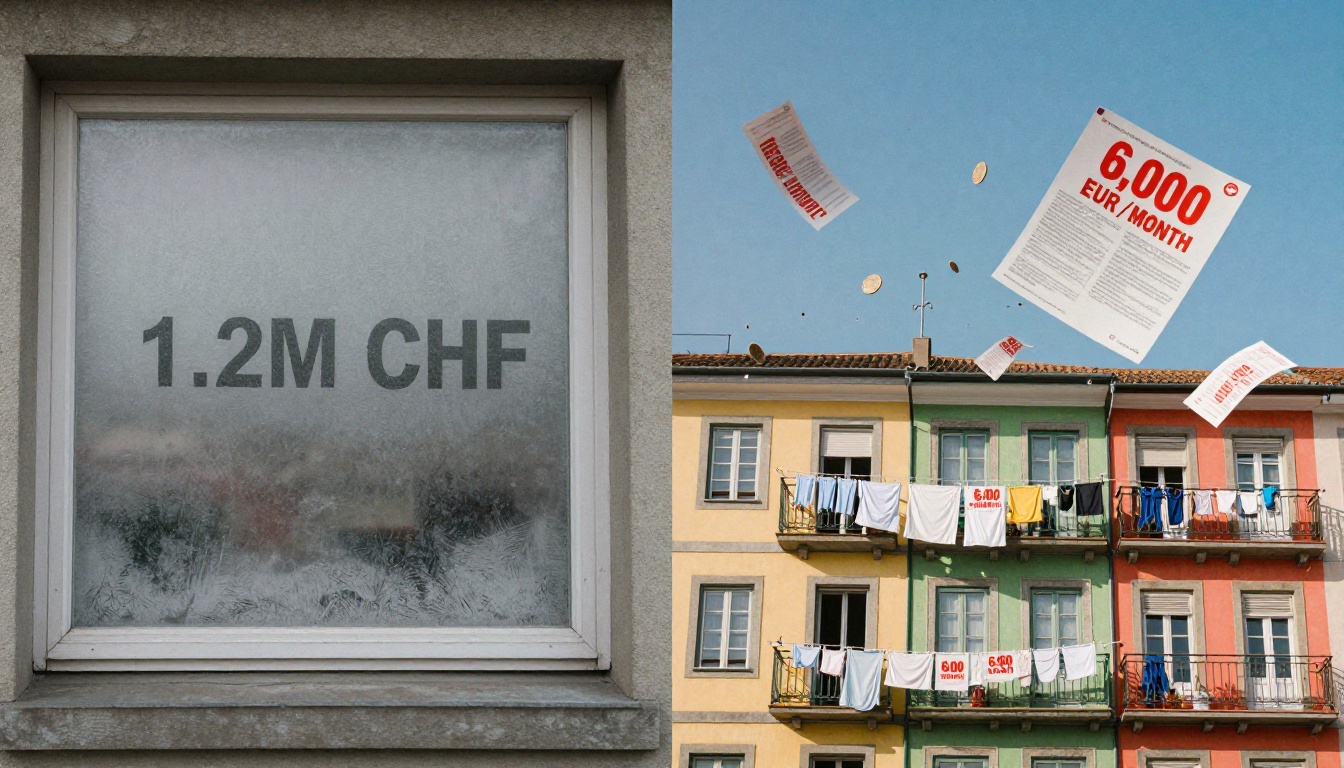
The math is brutal. A two-bedroom in Zurich’s outer districts commands 1.2 million CHF for a 70-square-meter box built in 1973. Your gross Mietrendite (rental yield) hovers around 2.8%. After Nebenkosten (additional costs) and mortgage payments, you’re lucky to break even. Meanwhile, a Swiss investor in Eastern Europe collects 6,000 EUR monthly from five apartments that cost less than half of that single Zurich flat. The question isn’t whether Swiss real estate is expensive, it’s whether owning any of it makes financial sense when foreign markets dangle returns that look like typos.
Around 800,000 Swiss citizens already voted with their feet, living abroad in France, Germany, and the USA according to the Eidgenössisches Departement für auswärtige Angelegenheiten (Federal Department of Foreign Affairs). Many didn’t just leave for jobs or love, they left because their capital works harder elsewhere. But before you transfer your Pensionskasse (pension fund) to a developer in Portugal, you need to understand what separates a successful foreign property strategy from an expensive headache.
The Swiss Property Trap: Where Capital Goes to Hibernate
Swiss real estate operates under a unique form of financial gravity. Prices rise steadily, but yields compress to the point where your investment barely qualifies as such. A property in Zug or Zurich might appreciate 3% annually while generating rental income that covers the mortgage and little else. One investor sold properties in Menzingen (Zug) and Stallikon (Zurich) because retirement math didn’t work: “As my wife is going into early retirement this year it is not affordable to live in Zug or Zurich as a retiree.”
The numbers confirm this sentiment. Gross yields in major Swiss cities rarely exceed 3.5%. After factoring in maintenance, administration, and the ever-present Nebenkosten (additional costs), your net yield often drops below 2%. Compare this to a global ETF like VT, which has delivered annualized returns of 8-10% over the past decade, and the Swiss property case weakens further. investment decision between real estate and financial assets under Swiss tax uncertainty becomes less about diversification and more about math.
Yet Swiss banks continue pushing domestic mortgages, and the cultural pressure to “own something concrete” remains strong. The problem? Your concrete is priced like gold bullion but performs like a savings account.
The Foreign Property Promise: When 6,000 EUR Monthly Becomes Reality
The Reddit thread that sparked this debate tells a different story. One investor built a portfolio of five apartments in Eastern Europe between 2018 and 2024. The result: 6,000 EUR in monthly rent against a 2,000 CHF Zurich rental payment. “Best decision ever”, they report. The properties, all in the upper/luxury segment and brand new, require minimal maintenance. A trusted local contact handles tenant issues, while contractors address any problems that arise.
This investor’s strategy relied on buying off-plan: 50,000 CHF down payments with the balance due in 2-3 years upon completion. No local mortgages, just personal loans in CHF. The projected return? Doubling the investment in ten years through a combination of 5% annual rent and 5% price appreciation.
Another investor swapped properties in Zug and Zurich for 4.3 hectares in Portugal’s Algarve, 1.4 hectares in France’s Medoc, and a cheap house in Kanton Jura, all debt-free. The motivation: zero mortgage payments and cars paid off. “The German speaking Kantons are great if you are working, but after that leave.” The beach near their French property sits seven kilometers away. The Swiss properties? Sold to someone else willing to accept the yield compression.
Even Germany offers better math. A property near Dortmund purchased for 71,000 EUR generates 700 EUR monthly net. That’s a gross yield over 11%, four times what you’d achieve in Zurich. current analysis of renting vs. buying in Switzerland, including tax and market trends shows the domestic market offers no such opportunities.
The Management Mirage: Why Local Knowledge Determines Success
The difference between profitable foreign property and a nightmare often comes down to one factor: local trust. The Eastern European investor succeeded because they had “a trusted person at the location.” Tenants stay for years, 3, 4, or more, reducing turnover costs. When issues arise, local contractors fix them without international phone tag.
Contrast this with the investor who plans to sell their Hungarian properties. “I have a company managing them but still too much of issues what can happen.” They prefer the emotional safety of eventually owning in Switzerland, despite lower returns. This sentiment echoes across forums: without a spouse from the area or deep local connections, foreigners risk getting “fleeced by the locals and stuck into burocratic / corruption issues.”
Spain’s market illustrates these pitfalls. While international buyers can negotiate 7.3% off asking prices in some regions, 63% report being misled about property conditions according to Funcas (2022). The “Ley de Transparencia” since January 2023 forces sellers to disclose defects in writing, but this only reduces negotiation room by 2.4%. Worse, oral promises can become legally binding, a fact that caught out buyers in the Smith vs. García (2021) case.

Smalltalk about football might smooth negotiations in Spain, but it won’t fix a foundation problem your “trusted contact” failed to spot. The 68% of German buyers who found cultural chat helpful still needed professional translators and lawyers to avoid the 82% error rate among those who negotiated without language support.
Returns vs. Risk: The ETF Comparison That Matters
The Eastern European investor’s claim of doubling money in ten years, 5% rent plus 5% appreciation, raises a critical question: does this beat a global ETF? They admit uncertainty: “I never checked if a world ETF doubles in 10 years.”
Historical data provides clarity. VT, Vanguard’s Total World Stock ETF, has delivered approximately 10% annualized returns over the past decade. A simple investment of 250,000 CHF in 2014 would have grown to over 600,000 CHF by 2024, requiring zero property management, no tenant disputes, and no currency conversion headaches.
Yet the property investor counters with leverage. Using 50,000 CHF down payments to control 250,000 CHF properties amplifies returns. If the property appreciates 5% annually, the 12,500 CHF gain represents a 25% return on the down payment. This calculation ignores currency risk, vacancy periods, and the illiquidity premium.
The Hungarian investor planning to sell reveals another truth: “Their value raised a lot, and the rent is just too low, putting the money in any ETF has a better return.” Even successful foreign property investors eventually question whether the hassle justifies the returns. diversifying beyond traditional Swiss investment norms, including real estate alternatives suggests sophisticated investors increasingly mix asset classes rather than going all-in on foreign property.
Swiss Tax Implications: The Quellensteuer Quagmire
Swiss residents must declare worldwide income and assets. Your 6,000 EUR monthly rent from Eastern Europe gets converted to CHF and added to your Swiss tax return. The Steueramt (tax office) in Zurich or Geneva will apply progressive rates, potentially pushing you into higher brackets.
Foreign properties also trigger wealth tax. A portfolio worth 600,000 EUR adds roughly 600,000 CHF to your taxable net worth. In Zurich, this incurs an additional 1,800 CHF annual wealth tax at typical rates. You can deduct foreign mortgages, but the income often outweighs the deductions.
The Quellensteuer (withholding tax) system complicates matters for foreign property income. While Switzerland can’t withhold at source on foreign rent, you must make quarterly tax prepayments if your final bill exceeds certain thresholds. Failure to plan means a 20,000 CHF surprise bill at year-end.
Using Pensionskasse (pension fund) money to finance foreign property triggers additional scrutiny. Early withdrawals for non-Swiss property face the same taxes as domestic purchases, but proving the property’s status to Swiss authorities requires extra paperwork. The überobligatorisch (extra-mandatory) portion of your pension can be withdrawn for foreign property, but the obligatorisch (mandatory) portion remains locked until retirement.
Currency Risk: The Silent Killer of Returns
That 6,000 EUR monthly rent looks less impressive when the EUR/CHF exchange rate moves against you. In early 2022, one euro bought 1.04 CHF. By late 2023, it bought only 0.94 CHF, a 10% drop. Your 6,000 EUR rent effectively fell from 6,240 CHF to 5,640 CHF without any change in tenant payments.
Swiss investors using CHF-denominated loans to buy foreign property face amplified risk. If you borrowed 500,000 CHF to buy EUR-denominated assets and the EUR drops 10%, your loan value in EUR terms increases 11%. This currency mismatch destroyed many Swiss investors who bought Spanish property before the 2008 crisis.
The Eastern European investor who used CHF personal loans created natural hedging. They earn EUR rent but owe CHF debt. When EUR/CHF falls, rent converts to fewer CHF, but the loan balance remains fixed in CHF terms. This works in reverse too, a strengthening EUR means more CHF to service the same CHF debt.
The Liquidity Trap: Why “Buy Abroad” Becomes “Stuck Abroad”
Swiss property sells slowly, but it sells. A Zurich apartment typically moves within 3-6 months at market price. Foreign property in emerging markets can take years to sell, especially if you insist on a fair price.
The Eastern European investor who started in 2018 now faces a changed market. Prices tripled, but liquidity vanished. “It is getting harder and harder”, they admit. The same properties that generated 6,000 EUR monthly now represent trapped capital, selling means losing the income stream, while holding means watching yields compress as prices rise.
The Portugal investor who bought 4.3 hectares in the Algarve owns a lifestyle asset, not an investment. Land that large generates no rental income and costs money to maintain. It represents a consumption choice masquerading as an investment decision, perfectly valid, but not a yield strategy.
Who Should Actually Do This?
Foreign property investment suits a specific profile: investors with substantial capital (500,000+ CHF), high risk tolerance, existing local connections, and the time to manage distant assets. It works best as part of a diversified strategy, not as a replacement for Swiss property or global ETFs.
The Eastern European investor succeeded because they:
– Started early (2018) before prices peaked
– Bought off-plan at significant discounts
– Had trusted local management
– Focused on luxury new builds requiring minimal maintenance
– Used CHF loans to create currency hedging
– Accepted the illiquidity as part of a long-term plan
The Portugal investor succeeded because they:
– Sold Swiss property at peak valuations
– Bought lifestyle assets for retirement, not yield
– Eliminated all debt to reduce risk
– Accepted that their properties generate income only if they choose to rent them seasonally
The German border investor succeeded because they:
– Bought at extremely low prices (71,000 EUR)
– Accepted moderate yields (11% gross) with low management overhead
– Financed through Schaffhausen Kantonal Bank, which understands cross-border risks
The Verdict: A Strategy, Not a Solution
Foreign property investment doesn’t replace Swiss homeownership, it serves different goals. Swiss property offers stability, tax advantages for residents, and a hedge against local inflation. Foreign property offers yield, diversification, and lifestyle flexibility. Most investors need neither extreme.
pitfalls of using corporate structures for Swiss property ownership, relevant when comparing domestic to foreign strategies reminds us that complexity often costs more than it saves. The simplest strategy, maximizing your Pensionskasse (pension fund) and Säule 3a (Third Pillar) contributions, then investing in global ETFs, beats most property plays for pure wealth building.
If you proceed with foreign property, follow these rules:
1. Never invest without local trust. A spouse, family member, or decade-long friend on the ground isn’t optional, it’s essential.
2. Keep CHF debt below 50% of property value. Currency leverage cuts both ways.
3. Budget 15% of purchase price for Nebenkosten (additional costs). Foreign transactions hide fees that Swiss buyers never see.
4. Declare everything to the Steueramt (tax office). Switzerland’s information exchange agreements mean they’ll find out eventually.
5. Limit foreign property to 20% of net worth. This ensures one bad tenant or legal dispute doesn’t derail your entire financial plan.
The 6,000 EUR monthly rent sounds fantastic until you factor in the 2:00 AM calls about burst pipes, the currency swings that erase quarterly gains, and the lawyer fees when a tenant decides to stop paying. For some, the yield justifies the hassle. For most, weighing homeownership in Switzerland against staying invested in liquid assets provides better sleep and similar long-term returns.
The smartest investors in the Reddit thread weren’t the ones collecting rent abroad. They were the ones who recognized that foreign property is a part-time job disguised as passive income, and priced their time accordingly.