The Swiss Mortgage Margin Game: Why Your Bank’s Published SARON Rates Are Pure Fiction
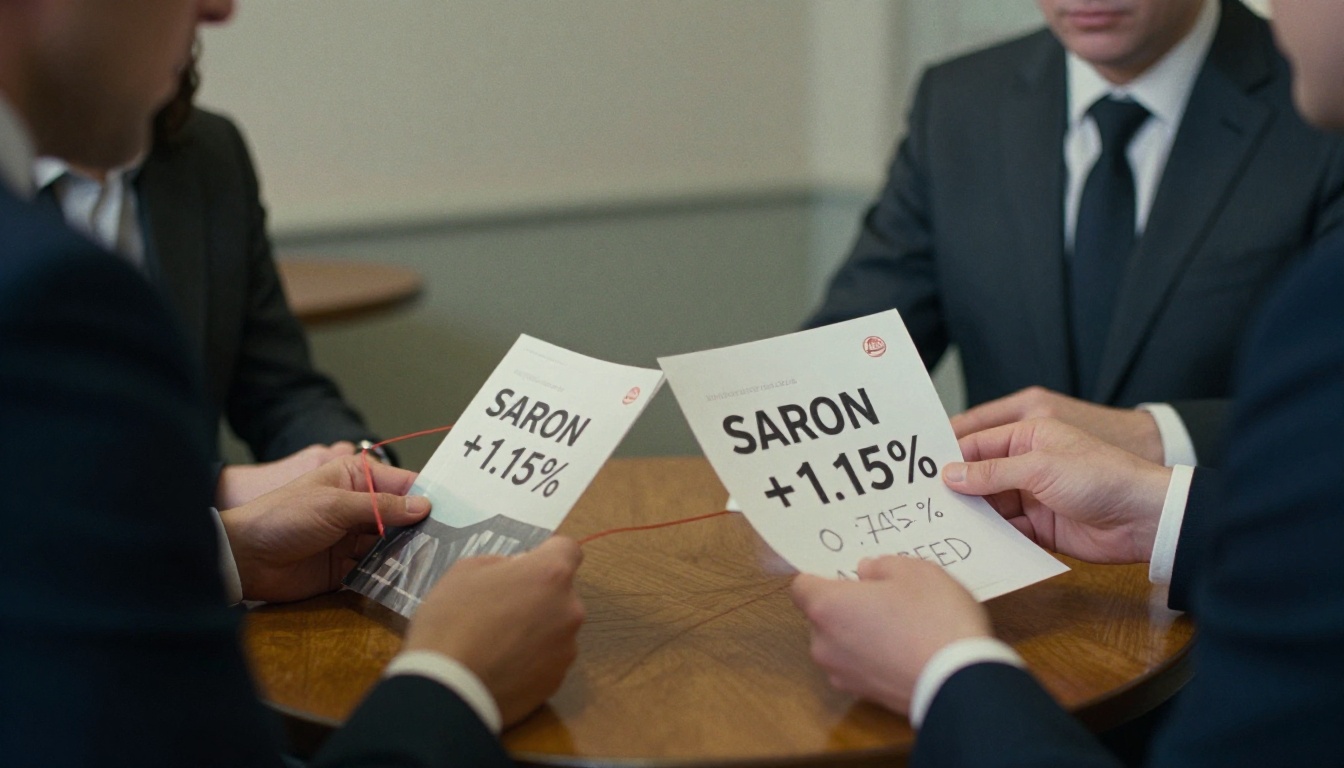
Walk into any Swiss bank branch and you’ll see SARON mortgage margins advertised around 1% to 1.2%. The numbers look official, printed on glossy brochures with the same precision as a Swiss watch catalog. But here’s what those brochures won’t tell you: private borrowers are routinely walking out with margins as low as 0.75% to 0.85%, sometimes after a single phone call.
The gap between advertised and actual rates isn’t a minor rounding error. It’s a deliberate negotiation game that Swiss banks play, and most borrowers don’t even realize they’re participants.
The Published Rate Mirage
Swiss mortgage comparison sites and bank websites display SARON margins that seem set in stone. Yet behind closed doors, these numbers flex more than a yoga instructor. According to recent market data, while publicly listed SARON margins hover around 1.15%, borrowers with decent financial profiles are securing rates at 0.8% to 0.9% through simple negotiation.
One borrower reported getting a 0.85% margin from Raiffeisen after their initial offer of 1% was immediately undercut by a competing bid from Mobiliar. Another secured a 0.75% rate from UBS for a 10-year term last summer. The pattern is clear: banks start high, expecting you to push back.
This pricing strategy isn’t random. Swiss banks operate on the assumption that most customers won’t negotiate, either out of cultural deference to financial institutions or simple lack of awareness. Those who do negotiate represent a small but profitable segment that banks want to keep, just not at the expense of their margin on the passive majority.
What Actually Determines Your Negotiating Power
Your ability to secure a lower SARON margin depends on several factors that go far beyond your credit score. Swiss banks evaluate customers through a specific lens:
- Financial Stability Indicators: Banks love customers who exceed affordability criteria (Tragbarkeit) comfortably. If you’re stretching to meet the minimum deposit or your debt-to-income ratio triggers warning lights, don’t expect flexibility. But if you earn well above the threshold and have substantial assets beyond the property, you’re holding stronger cards.
- Relationship Banking: That Lohnkonto (salary account) you’ve had for five years? It’s leverage. Banks routinely tie better mortgage rates to moving your primary banking relationship to their institution. One borrower reported that Raiffeisen dropped their margin to 0.85% on the condition of transferring their salary account, a single call, minimal hassle, significant savings.
- Loan-to-Value Ratio: The Belehnungsgrad (loan-to-value ratio) matters enormously. Borrowers with ratios below 65% typically receive the best offers, while those approaching 80% face stiffer margins. For a CHF 1 million property, that 15 percentage point difference represents CHF 150,000 in equity, and signals to the bank how much skin you have in the game.
- Cross-Border Complexity: If you have foreign income, assets abroad, or complex tax situations, banks may actually reduce their flexibility. The compliance overhead makes you a less attractive borrower, even if your income is high. This is where many international residents hit walls that Swiss nationals don’t encounter.
For a deeper understanding of how banks evaluate affordability beyond the headline numbers, see our analysis of Swiss mortgage affordability and bank lending criteria.
The Multi-Offer Strategy: Your Only Real Weapon
The golden rule of Swiss mortgage negotiation is simple: never walk in with just one offer. Banks respond to competition like clockwork, but only when they see it in writing.
- Get three written offers from different institutions, mix big banks (UBS, Credit Suisse), cantonal banks (ZKB, Berner Kantonalbank), and cooperatives (Raiffeisen).
- Present the best offer to your preferred bank, but frame it as a question: “I’d prefer to work with you, but this competitor is offering 0.85%. Can you match it?”
- Bundling services strategically. Banks will drop margins further if you bring your salary account, investment portfolio, or insurance products. The package deal matters more than any single product margin.
One borrower described their negotiation as “one call” after securing a competing offer. The bank didn’t just match the competitor’s rate, they undercut it slightly to secure the salary account transfer.
This approach works because Swiss banks operate in an oligopolistic market. They know each other’s pricing models intimately and would rather drop a margin by 0.15% than lose a profitable customer entirely. But they’re counting on you not to play the field.
Beyond the Margin: The Hidden Cost Trap
Focusing solely on the SARON margin is like buying a car based only on the sticker price. The real costs hide in the fine print:
- Account Fees: That “free” banking package might cost CHF 200-400 annually in account fees, effectively adding 0.02% to 0.04% to your real interest rate over time.
- Exit Conditions: SARON mortgages often contain clauses that make switching expensive. Some banks charge administrative fees for early termination, even though SARON is technically a variable product. Before signing, understand what it costs to leave.
- Amortization Requirements: The Eigenmietwert (imputed rental value) and direct amortization rules can turn a low margin into a high total cost. Banks may offer a great rate but require aggressive amortization that strains your cash flow.
- Property Valuation: Banks use conservative valuations. If their estimate comes in below your purchase price, your Belehnungsgrad jumps, and your margin follows. Negotiating the valuation is sometimes easier than negotiating the rate.
The research shows that many borrowers overlook these factors, focusing only on the headline margin. But a 0.85% margin with CHF 500 in annual fees and restrictive exit clauses may cost more over five years than a 0.95% margin with flexible terms.
SARON vs. Fixed: The Risk Premium Calculation
With 10-year fixed mortgages now available below 1.30%, the lowest since early 2022, the SARON vs. fixed debate has shifted. The premium for certainty has never been smaller.
Consider the math: If you secure a SARON margin of 0.85% and the SARON rate itself sits at 0.5%, you’re paying 1.35% effectively. A 10-year fixed mortgage at 1.27% to 1.37% costs essentially the same, but shields you from rate volatility.
The risk becomes stark when rates rise. A jump in SARON from 0% to 3% adds CHF 30,000 annually to a CHF 1 million mortgage, CHF 2,500 monthly. As one expert noted, borrowers often forget that this money comes directly from discretionary spending: vacations, hobbies, restaurants. Fixed costs like health insurance (Krankenkasse) and taxes (Steuern) can’t be cut.
The current market presents a rare window where the “insurance premium” for a fixed mortgage is minimal. While SARON enthusiasts argue that rates could fall, the downside risk of rising rates now outweighs the modest potential savings.
Practical Tactics for Immediate Action
Ready to negotiate? Here’s your playbook:
- Timing Matters: Approach banks in the last week of the month or quarter. Loan officers have targets to hit and become more flexible when deadlines loom.
- Use the Salary Account Leverage: Before your mortgage appointment, research what the bank offers for salary accounts. Frame the conversation around becoming a “full banking client”, not just a mortgage customer.
- Ask for the “Best Possible Rate”: Don’t accept the first offer. Ask specifically: “Is this your best possible margin for my profile?” The phrasing signals that you understand negotiation is possible.
- Quantify Your Value: Prepare a one-pager showing your assets, income stability, and low Belehnungsgrad. Make it easy for the banker to justify a lower rate to their risk department.
- Consider the Switch: If your current bank won’t budge, be prepared to move. The Swiss banking system makes switching more cumbersome than it should be, but the savings often justify the hassle. For insights on navigating this trade-off, see our guide on bank switching and financial negotiation habits in Switzerland.
The Bottom Line
The Swiss mortgage market operates on a simple principle: those who ask, receive. Banks publish high margins expecting negotiation, then reward borrowers who play the game with rates 20-30% lower than advertised.
But the game has rules. You need competing offers, a strong financial profile, and willingness to bundle services. You also need to look beyond the margin to total costs and exit flexibility.
With fixed rates now competitive with SARON margins, the negotiation game extends beyond variable products. Whether you choose SARON or fixed, the same principle applies: the advertised rate is just the opening bid.
Your mortgage is likely your largest financial commitment in Switzerland. Spending a few hours negotiating could save you CHF 10,000 to CHF 30,000 over a five-year period. That’s an hourly rate worth fighting for.
The banks won’t tell you this. But then again, they don’t need to. You just did.