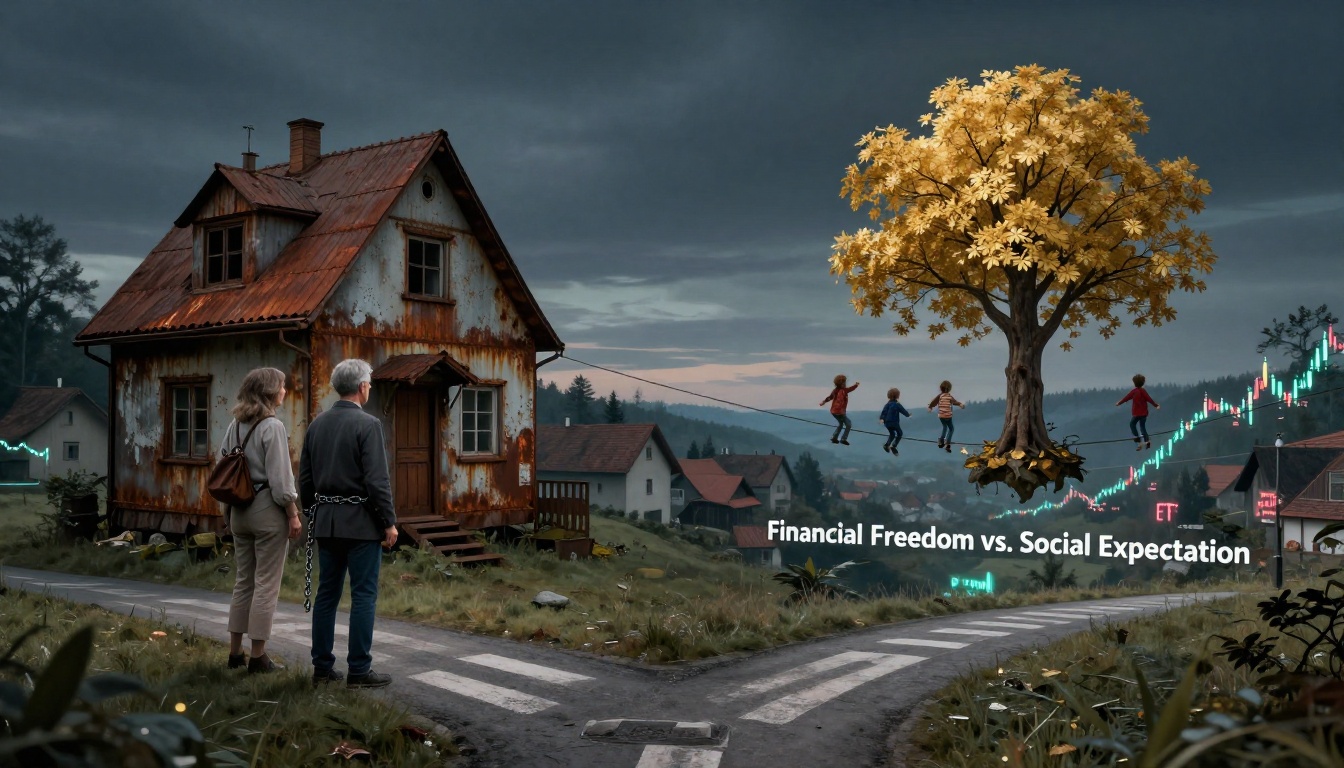
You’ve got four kids, €200,000 saved, and a monthly surplus that would make most German families weep with envy. By every metric, you’re winning at the financial game. Yet here you are, awake at 3 AM, staring at ImmoScout listings and wondering if you’re somehow failing your family by not owning property. Welcome to the most expensive identity crisis in modern German family life.
The scenario is brutally specific: mid-30s, children aged 1, 4, 7, and 10, renting a comfortable row house in a major German city for €2,000 warm (including utilities). Your ETF portfolio sits at €150,000, growing steadily. Your wife wants to buy. You, the numbers person, see a €600,000 house in the suburbs that would double your housing costs, destroy your savings, and sentence you to a life of commuting and car dependency. This isn’t a financial question anymore, it’s a question of what kind of life you actually want to live.
The Math That Makes Homeownership Look Like a Bad Deal
Let’s cut through the emotional fog and look at the cold, hard numbers. Your current situation: €2,000 rent for a place that fits six people comfortably. The alternative: a €600,000 house plus Nebenkosten (purchase costs) of around €60,000. Even with your €200,000 down payment, you’re looking at a €460,000 mortgage.
At current interest rates, your monthly payment would be roughly €2,500-€3,000, before we even talk about Grundsteuer (property tax), maintenance, or the second car you’ll need because that affordable house is 45 minutes from your job. Suddenly, your €3,000 monthly surplus evaporates. The €50,000 you kept “liquid” for a potential purchase? Gone in the first year.
Meanwhile, your ETF portfolio has been averaging returns that make real estate look sluggish. The Amundi MSCI World ETF, a common recommendation for German investors, has delivered annual returns around 12% before taxes over the past 17 years. Even after the 25% Abgeltungsteuer (capital gains tax), you’re looking at 9% net. Your €150,000 could reasonably grow to €350,000 in a decade without you lifting a finger.
The question isn’t whether you can afford a house. It’s why you would voluntarily trade a flexible, appreciating portfolio for an illiquid asset that will consume your time, money, and mental energy.
The Hidden Costs That Destroy the “Eigentum ist sicher” Myth
German culture worships property ownership like it’s the only path to financial security. But for your family, “sicher” (secure) looks suspiciously like a trap. That €600,000 house comes with invisible price tags:
The Commuting Tax: Stadtkinder (city kids) who move to the suburbs for “space” often underestimate the real cost. A longer commute isn’t just time, it’s €300-€500 monthly for a second car, plus insurance, maintenance, and the psychological toll of spending two hours daily in traffic instead of with your kids.
The Maintenance Monster: German houses are built to last, but everything breaks eventually. The rule of thumb is 1-2% of the property value annually for maintenance. That’s €6,000-€12,000 yearly, or €500-€1,000 monthly. Your landlord currently eats those costs. As an owner, you become the landlord.
The “Too Big” Problem: Your kids are 1, 4, 7, and 10. In 10 years, the oldest is 20, potentially moved out for studies. In 15 years, you could be two people rattling around a six-bedroom house in a suburb you never liked. Selling then means paying capital gains taxes and agent fees, while trying to appeal to families who want exactly what you no longer need.

Why Your Wife Wants to Buy (And Why She’s Not Wrong)
Here’s where pure financial analysis fails. Your wife’s desire for a house isn’t about ROI, it’s about control, permanence, and giving the kids a “real” home. In Germany, where renting means living with the sword of Eigenbedarfskündigung (owner’s personal use termination) dangling over your head, ownership feels like emotional insurance.
The risk is real. Your landlord has teenage kids. In 5-10 years, they might want the house for themselves. An Eigenbedarfskündigung would give you 3-6 months to find a new place, and good luck securing another rental for a family of six in today’s market. Your wife isn’t irrational, she’s risk-averse in a way that spreadsheets can’t capture.
But here’s the counterargument: with your financial cushion, you could survive a forced move. Your €200,000 in savings and €3,000 monthly surplus give you options. You could buy quickly if needed, or pay a premium for a new rental. The risk of moving is real, but the cost of preemptively buying is higher.
The Government Program Nobody Uses
The German government actually has a program designed for families like yours: “Jung kauft Alt” (Young buys Old). It subsidizes families with children who buy fixer-uppers in rural areas. The logic is sound, revitalize dying villages while giving families affordable housing.
The reality? In 2024, only 690 families used it. Why? Because renovating a 1970s farmhouse while working full-time and raising four kids is a recipe for divorce and bankruptcy. The program exists, but it’s not designed for Stadtkinder who value their weekends and sanity.
More relevant is the EH55 energy efficiency standard program, which the government reactivated in December 2025. It subsidizes efficient new builds, but that €600,000 house you’re eyeing likely doesn’t qualify. The programs are there, but they’re Band-Aids on a market that’s fundamentally broken for families like yours.
The Smarter Alternative: Build Wealth Without the Ball and Chain
Your instinct to buy 1-3 rental apartments instead of a primary residence is the most financially sound idea in your entire post. Here’s why:
Tax Advantages: Rental properties allow you to deduct interest, depreciation, and maintenance costs against your income. Your €3,000 monthly surplus could service a mortgage on a modest rental apartment, which your kids could later use for studies while you deduct the costs.
Flexibility: You keep your current lifestyle while building assets. No commuting, no second car, no suburban isolation.
Diversification: Real estate and ETFs don’t move in sync. When stocks crash, rental income keeps flowing. When the housing market stalls, your ETFs keep growing.
Time Horizon: Your kids need stability now. A rental property investment doesn’t disrupt their school, friends, or your family routine. In 15 years, when they’re grown, you can reassess where you want to live.
The stress you mention is real, being a landlord costs time. But so does owning a house. At least with rentals, you can hire a property manager. You can’t outsource fixing your own roof at midnight.
The Verdict: You’re Already Home
Here’s the uncomfortable truth: your family has achieved financial stability that most Germans can only dream of. You’ve done it by renting and investing wisely. The pressure to buy isn’t coming from your financial reality, it’s coming from cultural programming that says “real families own their homes.”
But look at what you’d be trading: €2,000 monthly rent for €3,000+ monthly ownership costs, a manageable city life for suburban car dependency, and a €150,000 liquid portfolio for a €600,000 illiquid anchor.
The real risk isn’t missing out on homeownership. It’s buying yourself into a life you don’t want, just as your kids are about to leave it. In 15 years, when your youngest is 16, you’ll want flexibility, not a mortgage on a house that’s too big in a place you never loved.
Keep renting. Keep investing. Maybe buy that rental property if you want real estate exposure. But don’t let the German obsession with Eigentum (ownership) turn your financial success into a lifestyle prison.
Your wife’s concerns about Eigenbedarf are valid, but they’re insurance against a risk, not a mandate to buy. Use your financial cushion as actual insurance. Keep the €50,000 liquid for emergencies, keep the ETFs growing, and revisit the question in 5 years when the market, and your family’s needs, might look completely different.
Sometimes the smartest financial move is recognizing that you’re already exactly where you need to be.
Internal Links for SEO:
For families navigating the rising home prices and generational divide in homeownership, the math has fundamentally changed. Your parents bought with 7 years of savings, you need 14. That reality check makes renting look less like failure and more like strategic adaptation.
The phenomenon of high consumption vs. low asset ownership in Germany explains why so many families feel cash-rich but asset-poor. You’re different, you’ve actually built assets. Don’t trade them for a consumption item dressed up as an investment.
Before you sign any Kaufvertrag (purchase agreement), understand the hidden property tax risks in Germany. That “bargain” house from a relative could trigger unexpected gift taxes that destroy your financial cushion.
Your situation reflects broader millennial financial challenges and delayed stability. The old playbook, study, work, buy house, doesn’t work when houses cost 10x annual income. You’ve found a workaround, don’t abandon it for nostalgia.
Finally, consider how rising interest costs impact personal finances and housing. The €460,000 mortgage you’re considering would have cost €800 monthly less three years ago. Timing matters, and right now, the timing favors staying put.