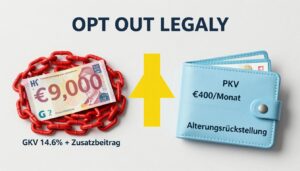
The €80k Health Insurance Paradox: Why Crossing Germany’s Salary Threshold Means More Costs and Tougher Choices

Crossing the €80,000 gross salary threshold in Germany triggers a bureaucratic rite of passage that few anticipate. Instead of champagne, you get a letter from your Krankenkasse (health insurance fund) politely informing you that you’re now a “Gutverdiener” (high earner) and your financial relationship with the healthcare system has fundamentally changed. Welcome to the world of freiwillige gesetzliche Krankenversicherung (voluntary statutory health insurance), where more income doesn’t automatically mean better coverage, but definitely means more complex decisions.
The “Congratulations, You Earn More” Letter That Confuses Everyone
That letter hitting your mailbox is the German healthcare system’s way of saying you’ve arrived. After years of paying percentage-based contributions that rose steadily with your salary, you’ve now hit the Beitragsbemessungsgrenze (contribution assessment ceiling). For 2025, this sits at €5,512.50 monthly, in 2026, it jumps to €5,812.50. What does this mean? Your contributions stop rising proportionally with your income. Instead, you pay the Höchstbeitrag (maximum contribution).
One recent career-changer earning €80,000 annually received exactly this notice, with their Krankenkasse asking whether they’d pay approximately €1,500 extra per year or if their employer would cover it. The confusion is understandable, this isn’t a negotiation point with your employer. It’s a legal transition point where your insurance status changes from Pflichtmitglied (compulsory member) to freiwilliges Mitglied (voluntary member), even if you stay in the statutory system.
Your employer continues paying half, but the calculation shifts. The Arbeitgeberanteil (employer contribution) now comes from a different budget line, it’s not deducted from your visible gross salary but from the employer’s gross payroll cost. In practice, this means your total compensation package remains the same, but how the accounting works changes. Many international residents report waiting weeks for clarification from HR departments who themselves struggle with these nuances.
The 2026 Squeeze: When Maximum Becomes More Maximum
Here’s where the financial pain becomes palpable. The 2026 adjustment to the Beitragsbemessungsgrenze means high earners will pay roughly €37 more monthly, totaling €447 annually. But that’s just the start. The real sting comes from the Zusatzbeitrag (additional contribution) that each Krankenkasse sets independently.
While the Bundesgesundheitsministerium (Federal Health Ministry) officially projects an average Zusatzbeitrag of 2.9% for 2026, the actual figure already stands at 3.13%. This gap isn’t incompetence, it’s deliberate. The official number excludes required reserve building, while real funds must cover actual costs. As TK chief Jens Baas bluntly stated, the official figure is a “Kommunikationskniff” (communication trick) that conveniently ignores financial reality.
For someone at the Beitragsbemessungsgrenze, this discrepancy translates to real money. The spread between the cheapest and most expensive Krankenkasse reaches 2.21 percentage points. At €5,812.50 monthly income, that’s a difference of €128 monthly or over €1,500 annually, just from choosing the right insurer.
The 2026 landscape shows over 30 Krankenkassen raising their Zusatzbeitrag, with some like BKK exklusiv increasing by a full percentage point. Only one major fund, Knappschaft, reduced theirs by 0.1 points, though they remain among the most expensive overall at 19% total contribution. The cheapest options cluster around 2.2-2.7%: BKK firmus (2.19%), TUI BKK (2.50%), hkk (2.59%), and the popular Techniker Krankenkasse (2.69%).
The PKV Fork in the Road: Freedom With Strings Attached
Crossing the Jahresentgeldgrenze (annual income threshold) of €69,300 doesn’t just trigger higher contributions, it opens the door to Private Krankenversicherung (private health insurance). This is the moment many high earners have waited for, but the decision is far from simple.
Staying in the GKV means predictable costs. Your contributions cap at the Höchstbeitrag, and family members can join through Familienversicherung (family insurance) at no extra cost. But you’re locked into a system where rising costs affect everyone, and you can’t customize coverage.
Switching to PKV offers potential savings for healthy, single individuals and lets you tailor your plan. However, it comes with Risikozuschläge (risk surcharges) for pre-existing conditions, Altersrückstellungen (age reserves) that increase over time, and the brutal reality that returning to GKV later is nearly impossible. Many international residents underestimate how PKV premiums climb with age, turning what seems like a smart move at 35 into a financial burden at 55.
Understanding how gross income thresholds impact net pay and social contributions becomes crucial here, as the decision affects not just current cash flow but decades of financial planning.
Self-Employed: The Documentation Nightmare
If you’re self-employed and crossing the €80k threshold, the rules morph into something resembling tax law. A Hamburg court case illustrates the danger: a selbstständig Tätiger (self-employed person) reported modest monthly earnings of €2,000-€2,600 but failed to provide complete tax documents. The Krankenkasse responded by retroactively imposing Höchstbeiträge from 2008-2011, creating a €10,179.48 Nachzahlung (back payment) demand.
The court upheld this decision, confirming that without vollständige Einkommensnachweise (complete income proof), funds can assume maximum earnings. For self-employed individuals, this means submitting ungeschwärzte Steuerbescheide (unredacted tax assessments) within three years of each calendar year’s end. Any gaps or redactions invite the Höchstbeitrag.
Since 2018, a small safety net exists: if you can prove income below the Mindestbeitragsbemessungsgrenze (minimum contribution assessment threshold) of €1,178.33 monthly (2024 figure), you can get retroactive adjustments. But for those earning above this line, the only protection is flawless paperwork.
Hidden pitfalls regarding health insurance contributions during income disruptions extend this principle, any gap in income documentation can trigger maximum contributions, even during periods of Elterngeld (parental benefit) or other temporary income reductions.
Employer Responsibilities: What They Actually Pay
The myth persists that employers stop contributing once you hit the Beitragsbemessungsgrenze. In reality, the Arbeitgeberanteil continues at the same maximum level as your employee contribution, just from a different pot of money. For 2026, both employee and employer will pay approximately €509 monthly each for someone at the ceiling, totaling €1,018.
What changes is transparency. Below the threshold, you see the contribution deducted from your gross salary. Above it, the employer’s half becomes part of their separate social security contribution calculation. Some HR departments mistakenly tell employees they’re “responsible for the full amount”, creating confusion about who’s paying what.
If you’re considering a Krankenkassenwechsel (health insurance switch), your employer doesn’t need to approve it. You simply apply to the new fund, which handles the transfer. The employer’s obligation remains identical, pay half the Beitrag (contribution) based on the Beitragsbemessungsgrenze, regardless of which Krankenkasse you choose.
The Optimization Playbook: Saving Money Without Switching Systems
Before leaping to PKV or accepting your current fund’s Zusatzbeitrag, explore these GKV optimization strategies:
- 1. Krankenkassenvergleich (Health insurance comparison)
The 2.21 percentage point spread between cheapest and most expensive funds translates to €1,500+ annual savings. Use independent comparison tools and check the fund’s actual Zusatzbeitrag, not just the advertised average. Funds must honor your switch if you’ve been insured for 12 months or received a contribution increase. - 2. Wahltarife (Optional tariffs)
Some funds offer deductible models (Selbstbehalt) that reduce your Zusatzbeitrag by 0.5-1 percentage points. You pay the first €500-€1,000 of annual treatment costs, after which normal coverage kicks in. This suits healthy high earners who rarely visit doctors. - 3. Bonusprogramme (Bonus programs)
While not reducing base contributions, preventive care participation can yield €200-€500 annual rebates through cashback or wellness incentives. The TK, for example, offers up to €400 yearly for gym memberships, check-ups, and health courses. - 4. Timing your switch
The special termination right (Sonderkündigungsrecht) activates when your fund raises the Zusatzbeitrag. You have one month to switch without waiting the usual 12-month period. With 33 funds raising rates for 2026, millions have this option now.
Recent political proposals regarding the €80,000 income threshold highlight how this salary level has become a lightning rod for broader debates about Germany’s social system fairness, making your insurance choice part of a larger economic conversation.
The Capital Income Connection: Where Healthcare Financing is Headed
The debate around high-earner contributions feeds into larger questions about how Germany funds its healthcare system. Broader context on healthcare system funding and capital contribution debates reveals that politicians are eyeing capital gains and investment income as future revenue sources. This matters because current rules already require freiwillig Versicherte to declare worldwide income, including capital gains, for contribution calculations.
If you’re a high earner with significant investment portfolios, your Krankenkasse can demand proof of capital income and include it in your Beitragsbemessung (contribution calculation). The SPD’s recent proposals to increase taxation on capital income to fund healthcare suggest this trend will intensify, potentially making your ETF dividends subject to higher health insurance contributions.
Making Your Decision: A Practical Checklist
Before making any moves, answer these questions:
- Family status: Married with children? GKV’s free Familienversicherung likely beats PKV’s family rates.
- Health profile: Chronic conditions? PKV risk surcharges could eliminate any savings.
- Income stability: Self-employed with fluctuating income? GKV’s predictable maximum offers budgeting certainty.
- Documentation discipline: Can you submit complete, unredacted tax documents annually? If not, self-employed GKV membership becomes expensive fast.
- Long-term plans: Planning to retire in Germany? PKV premiums accelerate with age, GKV costs stabilize relative to income.
The €80k threshold isn’t just a number, it’s a financial inflection point where Germany’s solidarity principle meets individual optimization. The system assumes you’ll either accept maximum contributions as your social duty or exit to private insurance. But the smart play is often neither: it’s mastering the art of Krankenkassenvergleich, understanding your documentation obligations, and treating health insurance as the strategic financial product it has become.
Your Krankenkasse letter isn’t a bill. It’s an invitation to a complex optimization game that most Germans play poorly. The winners aren’t necessarily those who earn the most, but those who navigate the rules with precision.