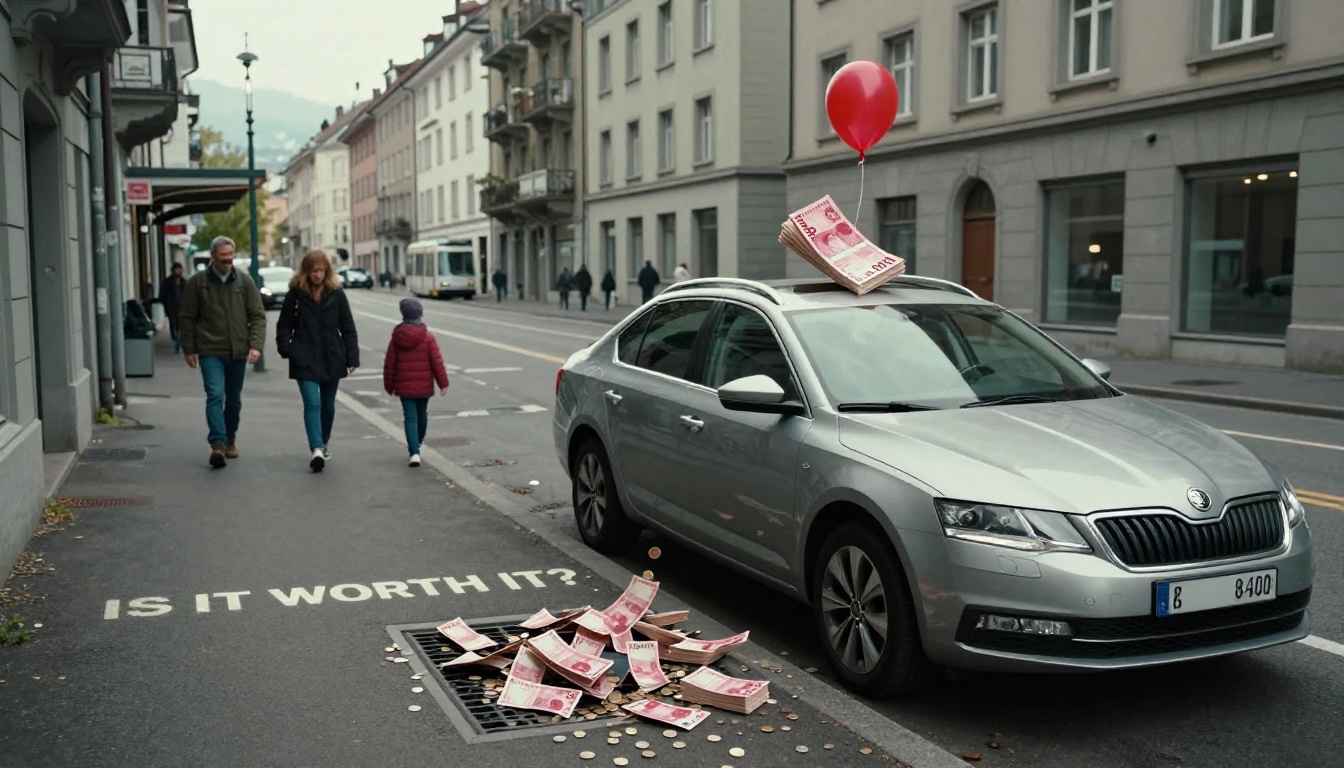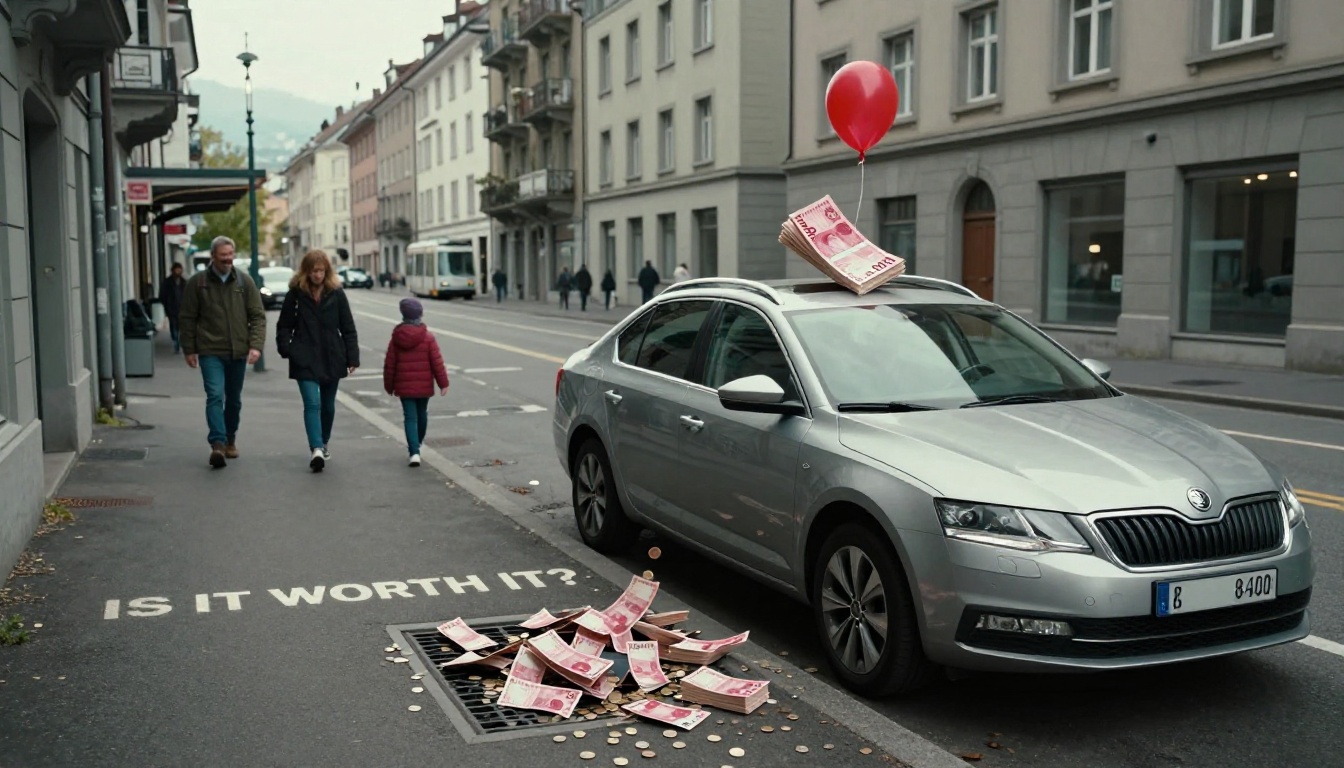
That used Skoda Octavia seems like a steal at CHF 20,000, until you realize it costs another CHF 8,400 every year just to keep it legal on Swiss roads. Many international residents discover this financial reality only after signing the purchase contract, when the first stack of bills arrives from the Steueramt (Tax Office), insurance company, and garage. The Swiss precision that makes the trains run on time applies equally to extracting money from car owners.
The dilemma facing many residents mirrors the Reddit user who sparked this discussion: remote worker, 30-minute walk to office, two young children, and a secure parking spot gathering dust. The math suggests CHF 3,000-5,000 annually for a "nice to have" convenience. But is that figure even complete? And more importantly, does the freedom of spontaneous rainy-day trips to the zoo justify the steady bleed from your bank account?
The Swiss Car Ownership Taxonomy: Where Your Money Actually Goes
Let’s dismantle the fantasy that buying a car is a one-time transaction. Swiss car ownership operates like a well-organized subscription service you can never cancel, only the subscription costs you CHF 500+ per month and occasionally breaks down on the A1 near Wankdorf.
The Fixed Cost Guillotine
Insurance (Kasko): Mandatory liability starts around CHF 300-400 annually for a clean record, but comprehensive coverage for anything newer than a 2010 Golf easily hits CHF 1,000-1,500. Live in Zurich? Add 20%. Under 25? Double it. One commenter reported CHF 1,000 for a 2017 Honda Civic, a realistic baseline for urban Switzerland.
Motor Vehicle Tax (Motorfahrzeugsteuer): This cantonal lottery ranges from CHF 100 in Appenzell to CHF 500+ in Geneva. The national average hovers around CHF 360, but your Gemeinde (municipality) can adjust this. Drive a diesel? Pay extra. Drive something with actual horsepower? Pay significantly extra.
Highway Vignette (Autobahn Vignette): The CHF 40 annual sticker feels trivial until you realize it’s essentially a tax for the privilege of driving on roads your general taxes already fund. The SBB (Swiss Federal Railways) analogy holds: you pay for the infrastructure whether you use it or not.
Parking: That "free" parking spot with your flat is the exception, not the rule. In Zurich’s Kreis 4, a residential permit costs CHF 300 annually, while a private garage runs CHF 150-250 per month. Geneva’s Blue Zone parking requires a CHF 15 annual permit plus CHF 1.50 per hour during the day. Even in smaller cities like Basel or Lausanne, expect CHF 800-1,200 yearly for something secure.
The Variable Cost Bleed
Fuel: At CHF 1.80-2.00 per liter, driving 13,000 km annually in a car consuming 6L/100km costs roughly CHF 1,400-1,560. That Honda Civic’s 5.3L/100km efficiency saves CHF 200-300 yearly, a small victory in an expensive game.
Maintenance and Repairs: The CHF 100 annual figure from our DIY oil-changer is fantasy for most. Swiss garages charge CHF 120-180 per hour. A basic service costs CHF 300-500. Budget CHF 600-1,000 annually for a car over 7 years old, or CHF 1,500+ for German luxury brands. The research suggests budgeting 0.5-1% of vehicle value yearly, which means CHF 150-300 for a CHF 30,000 car, but Swiss reality often doubles this.
Tyres: The CHF 200 annual average works if you amortize a CHF 800 set over four years. But winter tyres are mandatory, and storage costs CHF 80-150 yearly if you don’t have a Keller (basement).
MFK (Motorfahrzeugkontrolle): Switzerland’s rigorous inspection costs CHF 80-120 every two years, but fails for trivial issues like a cracked light lens or worn wiper blades. Factor in CHF 100-200 annually for pre-MFK fixes.
The Invisible Costs That Break The Budget
Depreciation: This is the assassin that murders your net worth quietly. A new car loses 20-30% when you drive off the lot, then 10-15% annually. That CHF 20,000 used Octavia? It’ll be worth CHF 12,000 in four years. That’s CHF 2,000 yearly in invisible losses, more than your insurance and tax combined. The Reddit user who suggested a 10+ year old car to "minimize depreciation" understands the math: after year 10, depreciation slows to a crawl, but maintenance costs accelerate to compensate.
Opportunity Cost: Park CHF 20,000 in a car instead of the stock market? At 7% average returns, that’s CHF 1,400 yearly in foregone gains. Even at 3% in a savings account, it’s CHF 600. The research on automobile ownership costs consistently misses this, your car isn’t just costing money, it’s preventing money from making money.
The Urban Family Dilemma: Why Cities Make Cars Financially Absurd
Here’s where Swiss reality gets spicy. The same family that "needs" a car for kids’ activities lives within 500 meters of a tram stop that connects to a train network spanning the entire country. The SBB’s GA (General Abonnement) costs CHF 3,860 annually for unlimited travel. A Halbtax (half-fare card) is CHF 185 yearly. For CHF 5,000, the lower end of car ownership costs, you could rent a car every single weekend and still save money.
Yet the psychological pull remains. "It’s really annoying if it’s raining or I need to take the kids somewhere", our Reddit author confesses. This is the convenience tax, a premium paid not for mobility, but for spontaneity. The question isn’t whether you need transport, but whether you need on-demand, weather-proof, cargo-capable transport.
In Zurich, a Mobility Carsharing membership costs CHF 200 annually plus CHF 2-4 per hour. For the 50-80 hours yearly that most urban families actually "need" a car, that’s CHF 400-520 total. Add CHF 1,000 for occasional longer rentals, and you’re at CHF 1,500, less than one-third of ownership costs.
The math is brutal: owning a car in a Swiss city for occasional use is like buying a restaurant because you don’t want to wait for pizza delivery.
The EV Wildcard: How Electric Changes Swiss Math
The commenter with an EV reporting 0.8-0.9 CHF/km running costs is onto something. In Switzerland, where electricity costs CHF 0.20-0.25 per kWh, charging at home costs roughly CHF 3-4 per 100 km, one-third of petrol costs. Maintenance drops by 40-50%: no oil changes, fewer moving parts, regenerative braking reducing pad wear.
But the upfront premium remains. A new VW ID.3 costs CHF 15,000 more than a comparable Golf. Federal incentives? CHF 0. The canton of Zurich offers CHF 1,000-3,000 for EVs, but only until the budget runs out (usually by March). Geneva and Ticino have similar programs, but Bern and Vaud offer nothing.
The breakeven point for EVs in Switzerland lands around 80,000-100,000 km, roughly 6-8 years for average drivers. For our low-use urban family? Never. The depreciation on EVs is also more volatile, a 2023 model might lose 25% when the 2024 refresh arrives with 50 km more range.
The research on EV lifecycle costing shows the same pattern: lower running costs, higher upfront costs, uncertain depreciation. In Switzerland’s expensive electricity market (compared to France or Norway), the advantage narrows further.
The "Shitbox" Strategy: Swiss Edition
The commenter recommending a "shitbox" pre-2010 car for serviceability hits a Swiss bureaucratic wall. Cars older than 10 years face stricter MFK inspections, and parts availability becomes problematic. Insurance companies charge more for liability on older vehicles, and many garages refuse to work on them.
Yet the strategy has merit. A CHF 3,000-5,000 Golf Mk4 or Civic from 2005 depreciates maybe CHF 300 yearly. Insurance drops to CHF 400. You can self-service simple repairs. Total annual cost: CHF 1,500-2,000. The catch? It’ll fail the MFK eventually, and Swiss scrappage rules mean you can’t just keep it running indefinitely. The "therapy" of working on your own car also requires a garage space, rare and expensive in cities.
When The Math Doesn’t Matter: The Psychological Premium
Here’s the uncomfortable truth: for many Swiss families, the car isn’t a financial decision, it’s an emotional one. The freedom to visit grandparents in Appenzell without checking train schedules. The ability to haul a new Billy bookshelf from Ikea. The security of knowing a 3 AM hospital run with a sick child doesn’t involve waiting for a night bus.
These scenarios occur maybe 5-10 times yearly, but their psychological weight exceeds their financial cost. The research on automobile ownership costs rarely quantifies this: the value of optionality. In finance terms, owning a car is like holding a call option on convenience, you pay a premium for the right, but not the obligation, to use it.
The question shifts from "Is it worth CHF 5,000?" to "Is it worth CHF 5,000 for the peace of mind?" For a dual-income family earning CHF 150,000+ in Zurich, that’s 3% of gross income. For a single parent in Lausanne earning CHF 60,000, it’s 8%, a crushing burden.
The Verdict: A Decision Framework
Stop asking "Is a car worth it?" and start asking "What’s my cost per use?"
Calculate your actual annual usage. Track every trip for a month. If you’re below 8,000 km and live within 1 km of public transport, the math rarely works. If you’re above 12,000 km or have regular needs that public transport can’t serve (elderly relatives, special needs children, rural hobbies), the balance shifts.
The Reddit user’s instinct is correct: a 10+ year old car minimizes depreciation, but Swiss regulations and maintenance costs create a floor around CHF 2,500-3,000 yearly. For their described usage pattern, remote work, 30-minute walk to office, occasional family trips, the answer is clear: don’t buy. Invest the CHF 5,000 yearly in a Mobility membership, SBB passes, and rental cars. The compound interest alone will fund a nicer car later, when needs actually change.
But if that parking spot represents security, and the thought of rainy-day tram rides with two toddlers triggers anxiety, then the psychological premium might justify the financial penalty. Just don’t pretend it’s an investment, it’s a luxury convenience tax, plain and simple.
The Swiss banking system operates with the same reliability as an SBB train, usually impeccable, until construction slows the line. Car ownership in Switzerland is that construction: predictable delays and costs that make you question why you didn’t just take the train in the first place.
For a detailed breakdown of annual car ownership costs in Switzerland, the numbers reveal even more surprising expenses. And when comparing long-term ownership costs: car vs. property in Switzerland, the car almost always looks worse, property appreciates while cars dissolve into rust and regret.
The final answer? Do the math, then ignore it and do what lets you sleep at night. Just don’t complain when the MFK bill arrives.