Germany ranks among Europe’s top earners. Your paycheck says so. The statistics confirm it. Yet when it comes to actual wealth, the kind that buys freedom, funds retirement, or weathers crises, Germans are barely middle-class. The median household net worth sits at €106,600, a figure that places the EU’s economic powerhouse behind Slovenia, Italy, and France. The gap between income and wealth has become a national blind spot, and the uncomfortable truth is that policy isn’t to blame. Germans are doing this to themselves.
The Slovenian Reality Check
The numbers from the European Central Bank’s latest Household Finance and Consumption Survey paint a stark picture. While German wages compete for the top spot in Europe, median wealth tells a different story. A Slovenian household, on average, holds more net assets than its German counterpart. This isn’t about inequality in the classic sense, though Germany’s Gini coefficient of 0.73 reveals extreme wealth concentration, but about a systemic failure to convert high earnings into lasting assets.
The Süddeutsche Zeitung recently captured the essence of this paradox: Germans simply don’t know what to do with their money once it lands in their accounts. The problem isn’t that the state takes too much, though social contributions are substantial. It’s what happens, or doesn’t happen, with the remainder that defines this crisis.
The 80% Problem
Here’s the statistic that explains everything: 80% of Germans have no securities account whatsoever. No stocks, no ETFs, no bonds. Their savings rot in accounts earning next to nothing, or get locked into insurance products with returns that barely beat inflation. This isn’t speculation, it’s the documented reality of a nation that confuses saving with building wealth.
The cultural roots run deep. Post-war generations internalized a simple mantra: debt is dangerous, stocks are gambling, and property is the only safe bet. Banks reinforced this message, steering customers toward “secure” products like Bausparverträge and complex insurance vehicles while warning against the volatility of markets. The result? A population that treats its Girokonto like a wealth-building tool while dismissing ETFs as reckless speculation.
Many international residents observe this phenomenon with bewilderment. Colleagues earning six-figure salaries keep six-figure balances in Sparkasse accounts earning 0.02% interest, proudly announcing they’ve “saved” another €20,000 while inflation devours its purchasing power. The psychological comfort of seeing a stable number outweighs the mathematical certainty of losing wealth slowly.
The Property Trap
Real estate has become Germany’s substitute for real investing. The logic seems sound: buy a house, pay no rent for 40 years, sell at triple the price. But this narrative collapses under scrutiny. A €1 million property today requires €100,000 in upfront costs, Grunderwerbsteuer, Notar, Makler, that can’t be financed and must come from after-tax savings. In cities where homeownership rates have plummeted from 42% to 20-22%, this strategy has become a lottery for the already-wealthy.
Even for those who manage to buy, the math rarely works. As one commenter pointed out, a property that merely triples in value over 40 years significantly underperforms a simple MSCI World ETF, which would have turned the same initial capital into 26 times its original value. Germans celebrate their “paid-off house” while ignoring the opportunity cost that left them poorer than their renting, investing counterparts.
The system actively discourages ownership. Grunderwerbsteuer rates climb toward 10% in some states, adding a six-figure tax bill to every purchase. Makler fees, still percentage-based on inflated property values, deliver windfalls to agents for minimal work. The entire structure punishes buyers while subsidizing renters, who then face a rental market so broken that couples can’t find shared apartments, let alone family-sized ones.
Where Your Salary Actually Goes
The disconnect between gross and net creates another layer of confusion. A €4,000 monthly gross salary costs your employer €4,850 after social contributions. You receive €2,650. That’s a 45% effective burden before you even touch a euro.
Progressive taxation means a €1,000 raise only adds €540 to your net pay. The rest vanishes into systems promising future security that may not exist when you need it. Pension contributions consume nearly 20% of gross income, yet demographic collapse guarantees that today’s workers won’t receive comparable benefits. The money flows out, but the wealth never materializes.
Many employers obscure this reality by showing only the employee side of the equation. Transparency would reveal that for every €100 an employer spends on compensation, just €55 reaches the employee’s pocket. The remaining €45 funds systems that, while providing social safety, fail to create personal wealth.
Generational Denial vs. Emerging Awareness
Boomers who bought property decades ago now sit on million-euro assets, convinced their experience represents timeless wisdom. They saved in accounts earning 5-7% during the 1980s and 90s, a strategy that can’t be replicated when interest rates hover near zero. Their wealth resulted from timing and luck, not financial sophistication, yet they dispense advice that keeps younger generations poor.
Meanwhile, a counter-movement is forming. Professionals in their 30s and 40s, particularly engineers and tech workers, have started building ETF portfolios. The pandemic accelerated this shift, with many discovering that automated investing beats saving. But they’re the minority. For every young professional dollar-cost averaging into global indices, five colleagues are leasing new cars every three years or parking cash in Tagesgeldkonten.
The gap between perception and reality remains vast. One commenter noted their entire friend group now invests, creating a bubble of false consensus. Outside these circles, the 80% statistic holds firm. Germany’s financial literacy hasn’t improved, it’s just partitioned into increasingly isolated subcultures.
The ETF Revolution That Wasn’t
ETFs should have been Germany’s financial awakening. Low-cost, diversified, and accessible, they solve every objection Germans historically raised about stocks. Yet adoption remains anemic. The reason isn’t rational, it’s emotional. Decades of anti-equity propaganda created a population that would rather earn negative real returns than confront the “risk” of markets.
Those who do invest often make classic mistakes: holding individual stocks like Commerzbank or Deutsche Telekom for decades, mistaking brand familiarity for investment quality. Others buy expensive actively-managed funds from their Sparkasse advisor, the same person who warned them about ETFs, paying 2% annual fees for performance that lags index funds by 3-4%.
The cognitive dissonance is striking. Germans obsess over every cent spent on groceries, then commit six-figure sums to property purchases with minimal analysis. They’ll spend hours comparing gas prices but minutes, or seconds, deciding where to park their life savings.
What This Means for Your Financial Future
If you’re earning a German salary and building wealth feels impossible, the system isn’t the primary obstacle. Your behavior is. Every euro left in a savings account is a euro actively losing value. Every year spent waiting for “the right time” to invest is a year of compounded returns forfeited.
The math is brutal but clear. A median German household with €106,600 in net wealth could double that in a decade by simply moving cash to a diversified ETF portfolio, assuming historical average returns. Instead, most will see their purchasing power erode by 20-30% over the same period through inflation.
The housing market won’t save you. Prices are already elevated, and demographic trends suggest stagnation in many regions. The pension system won’t save you. Contribution rates will rise while benefits fall. Only direct ownership of productive assets, stocks, bonds, real estate investment trusts, creates wealth, and 80% of Germans are functionally allergic to this reality.
Breaking the Cycle
Wealth building in Germany requires unlearning national myths. Start with a Wertpapierdepot. Not tomorrow. Today. Transfer €100 monthly into a global equity ETF. Increase it as you cut unnecessary consumption, like that car upgrade you were considering.
Stop treating property as religion. Renting plus investing historically outperforms homeownership in Germany’s current market structure. If you must buy, treat it as a lifestyle choice, not an investment.
Demand transparency from employers. Ask for your total compensation cost. Understand that €4,850 in employer spending only yields €2,650 in disposable income. Negotiate from that baseline, not from gross salary figures that mislead both parties.
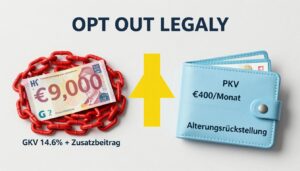
Most importantly, recognize that German financial culture is optimized for psychological comfort, not wealth creation. The system works exactly as designed, to provide stability and security at the cost of growth. If you want more, you must opt out of the consensus. Your Slovenian counterpart already has.
The wealth gap between Germany and its neighbors isn’t closing. It’s widening. Salaries will continue rising. Wealth will continue stagnating. Until Germans confront their investment aversion, they’ll remain the continent’s highest-paid poor people. The choice is simple: comfort of the known or wealth of the possible. One glance at your net worth should tell you which path you’ve chosen.