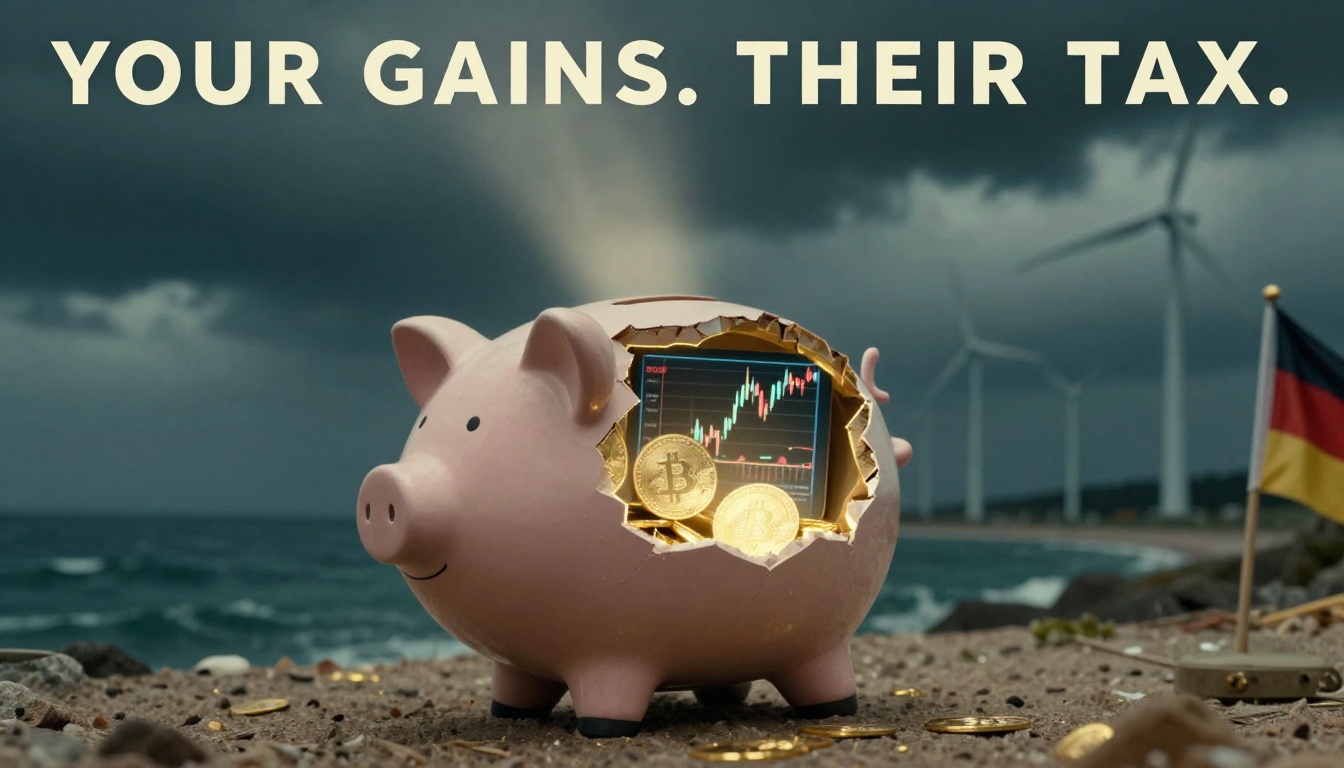
The Dutch parliament just approved one of the most radical wealth tax reforms in modern European history, and the tremors are already being felt in German investment communities. Starting in 2028, the Netherlands will tax actual value increases, including unrealized gains, at rates that could reach 36%. For anyone holding ETFs, stocks, or crypto across the border, this isn’t just Dutch domestic policy. It’s a potential blueprint that German lawmakers are already examining.
From Fiction to Reality: The Box 3 Revolution
For over two decades, Dutch investors lived under the bizarre Box 3 (Box 3) system where the government taxed fictional returns. You paid levies on presumed profits that you might never have earned. Conservative savers with low-yield accounts got hammered while volatile asset holders sometimes caught a break. The Dutch Supreme Court finally pulled the plug in 2021, ruling this violated basic property rights and equal treatment principles.
The government’s response? Replace fiction with brutal reality. The new “Wet werkelijk rendement box 3” (Actual Returns Box 3 Law) abandons presumed returns entirely. Instead, it taxes the actual annual change in your portfolio’s value, whether you sold anything or not. The system passed its critical parliamentary vote on February 12, 2026, and now faces only Senate approval before becoming law on January 1, 2028.
The Math That Keeps German Investors Awake
Here’s where it gets uncomfortable for anyone watching from Berlin or Munich. The reform explicitly targets private investment assets: stocks, ETFs, bonds, bank balances, precious metals, and crucially, Bitcoin and other cryptocurrencies. The tax rate sits at approximately 36% on gains.
Consider a concrete scenario that’s circulating in German financial forums: You hold Bitcoin worth €70,000 on January 1st. By year’s end, it’s valued at €100,000. That’s a €30,000 unrealized gain. Under the new rules, you owe roughly €10,800 in tax, despite never selling a single satoshi.
The kicker? That tax bill arrives with your regular tax assessment in spring of the following year. If Bitcoin crashes back to €60,000 before you pay, you still owe the full €10,800. You might have to sell your devalued assets at a loss just to cover a tax bill on profits that no longer exist. This forced selling scenario has German crypto holders particularly rattled.
The Liquidity Trap: When Paper Profits Become Real Bills
The core innovation, or depending on your perspective, the core insanity, is taxing paper wealth while ignoring cash flow reality. Traditional tax systems wait for a realization event: you sell, you pay. This new approach severs that connection entirely.
Many German investors initially compared it to Germany’s Vorabpauschale (advance lump-sum tax) on investment funds. But the comparison falls apart quickly. The German system ties the tax to a base interest rate, it’s typically small, and crucially, it gets credited against your final capital gains tax when you actually sell. The Dutch model taxes the full paper gain annually with no such credit mechanism.
A senior analyst at Leverage Shares & Income Shares notes that without inflation adjustment, even nominal value increases get fully taxed. In an inflationary environment, you could pay 36% tax on gains that merely preserve your purchasing power.
Who Actually Gets Hit? (Hint: Not Just “The Rich”)
Dutch politicians sold this reform by emphasizing fairness and targeting wealthy tax avoiders. The reality? The net catches anyone with meaningful investments.
The reform exempts self-used real estate and business assets held in corporations. That sounds reasonable until you realize who that leaves exposed: middle-class ETF savers building retirement portfolios, young professionals accumulating crypto, and families with modest rental properties.
One analysis from the Blocktrainer community points out that wealthy individuals simply route assets through corporate structures or hold multiple self-used properties. The middle class lacks these escape hatches. As one commenter summarized: “The rich laugh, the middle class pays.”
A €1,800 tax-free allowance per person exists, but above that threshold, the 36% rate kicks in aggressively. For a German couple with a combined €200,000 in ETFs generating a typical 7% annual return, that’s roughly €5,000 in Dutch-style tax annually, on gains they haven’t banked.
The German Connection: Why This Isn’t Just Dutch Business
German investors have reasons beyond curiosity to monitor this experiment. The Netherlands shares the EU legal framework, faces similar demographic pressures, and operates under comparable social market economy principles. If the Dutch can implement this without capital flight or constitutional crisis, German policymakers will take notes.
And they’re already looking. The SPD’s (Social Democratic Party) recent proposals to extend health insurance contributions to capital income show German tax authorities are searching for new revenue sources. One internal analysis warns that German coalition negotiations already floated higher capital gains taxes to fund healthcare deficits.
The current German system taxes capital gains at 25% plus solidarity surcharge when you sell. But with Germany’s healthcare financing system operating with the same efficiency as a Deutsche Bahn train, usually predictable until construction work appears on your line, politicians eye the Dutch model as a way to accelerate revenue collection.
detailed explanation of the Dutch 38% tax on paper gains as a warning for German investors
Political Domino Theory: Could This Happen Here?
Constitutional lawyers suggest the Dutch reform survived because it replaced an already flawed system ruled illegal by their Supreme Court. Germany’s Grundgesetz (Basic Law) protects property, but it doesn’t guarantee unlimited tax deferral on unrealized gains.
The political pathway matters more than the legal one. German finance minister discussions in 2025 already included capital gains tax increases. The Netherlands provides a ready-made template. As one German tax blogger observed, “I suspect if Germany adopted this, they’d call it typically German efficiency.”
The critical factor: the Dutch reform addresses a specific legal vulnerability. Germany lacks that immediate pressure. But with coalition partners needing revenue for social spending promises and the Dutch showing it can be done, the temptation grows.
What German Investors Should Actually Do
Panic-selling your portfolio helps no one. But strategic preparation makes sense:
1. Diversify Across Jurisdictions
Don’t concentrate all assets in Dutch domiciled funds or brokers. While the tax applies to residents, not funds, jurisdictional diversification reduces policy risk. Consider German, Irish, or Luxembourg domiciled ETFs instead of Dutch ones like the popular VanEck Morningstar NL0011683594.
2. Review Your Liquidity Position
If Germany ever adopted this, you’d need cash reserves to pay tax on paper gains. Build a liquid emergency fund that could cover 20-30% of your typical annual portfolio appreciation without forcing asset sales.
3. Monitor Political Developments
Track SPD and Green party tax proposals. The proposed SPD tax on capital income including ETFs and investments shows the direction of travel. German election cycles bring new coalition possibilities.
4. Consider Corporate Structures
Wealthy Dutch investors are already shifting private assets into corporate holdings. For Germans with substantial portfolios, consulting a tax advisor about GmbH (limited liability company) structures becomes prudent, not for evasion, but for legitimate tax planning.
5. Calculate Your Exposure
Run the numbers: If you had to pay 36% on last year’s unrealized gains, what’s your bill? Could you pay it without selling? This stress test reveals vulnerabilities.
direct analysis of Dutch-style unrealized gains tax and its potential adoption in Germany
The Exemption Game: What Stays Untouched
The Dutch reform includes carve-outs that reveal political priorities. Self-used real estate remains exempt, protecting homeowners but creating massive distortions. Why hold volatile stocks when your primary residence grows tax-free? This perversely pushes capital into illiquid housing, exactly what Germany struggles with.
Business assets in corporations also escape, incentivizing wealthy Dutch to incorporate investment holdings. Expect a boom in Dutch private family offices and corporate shells.
For German observers, these exemptions show how such taxes create new distortions while claiming to fix old ones. The Mittelstand (middle class) with straightforward ETF portfolios gets hit, the wealthy with sophisticated structures navigate around.
The Verdict: A Warning, Not a Death Sentence
The Dutch unrealized gains tax represents a structural break with how Europe has taxed investments for generations. Its 36% rate, annual taxation of paper profits, and liquidity risks make it hostile to long-term retail investors.
For German investors, this isn’t an immediate catastrophe but a flashing warning light. The policy exists, it’s passed parliament, and it demonstrates that “unthinkable” tax reforms can become law quickly when courts and legislatures align.
The most likely German scenario isn’t direct copying but selective borrowing. Perhaps crypto gets targeted first, as it’s politically unpopular. Or maybe the Vorabpauschale gets expanded beyond its current limited scope. The SPD proposal to extend health contributions to all income including investment gains already shows movement in this direction.
German investors should treat the Dutch reform as a live policy experiment. If Netherlands’ tax revenues surge without capital flight, German finance ministry officials will absolutely study the model. If wealthy Dutch investors flee to Germany or Switzerland, that becomes a cautionary tale.

Actionable Takeaways for German Investors
- Audit your portfolio’s tax efficiency under extreme scenarios. Could you survive a 36% tax on unrealized gains?
- Build liquidity reserves equal to at least 6 months of living expenses plus 20% of your typical annual portfolio appreciation.
- Diversify geographically across fund domiciles and broker locations, not just asset classes.
- Follow German coalition politics closely. Tax changes emerge from coalition agreements, not election campaigns.
- Consult a Steuerberater (tax advisor) about corporate structures if your portfolio exceeds €500,000. The cost is worth the planning security.
- Document everything. If Germany adopts similar rules, proving cost basis and acquisition dates becomes critical.
The Dutch unrealized gains tax isn’t coming to Germany tomorrow. But it’s no longer unthinkable. For German investors building wealth through stocks, ETFs, and crypto, the message is clear: optimize for a world where paper profits create real tax bills, because our neighbors just made that world a reality.
rising tax burden on middle-class Germans and implications for investment taxation