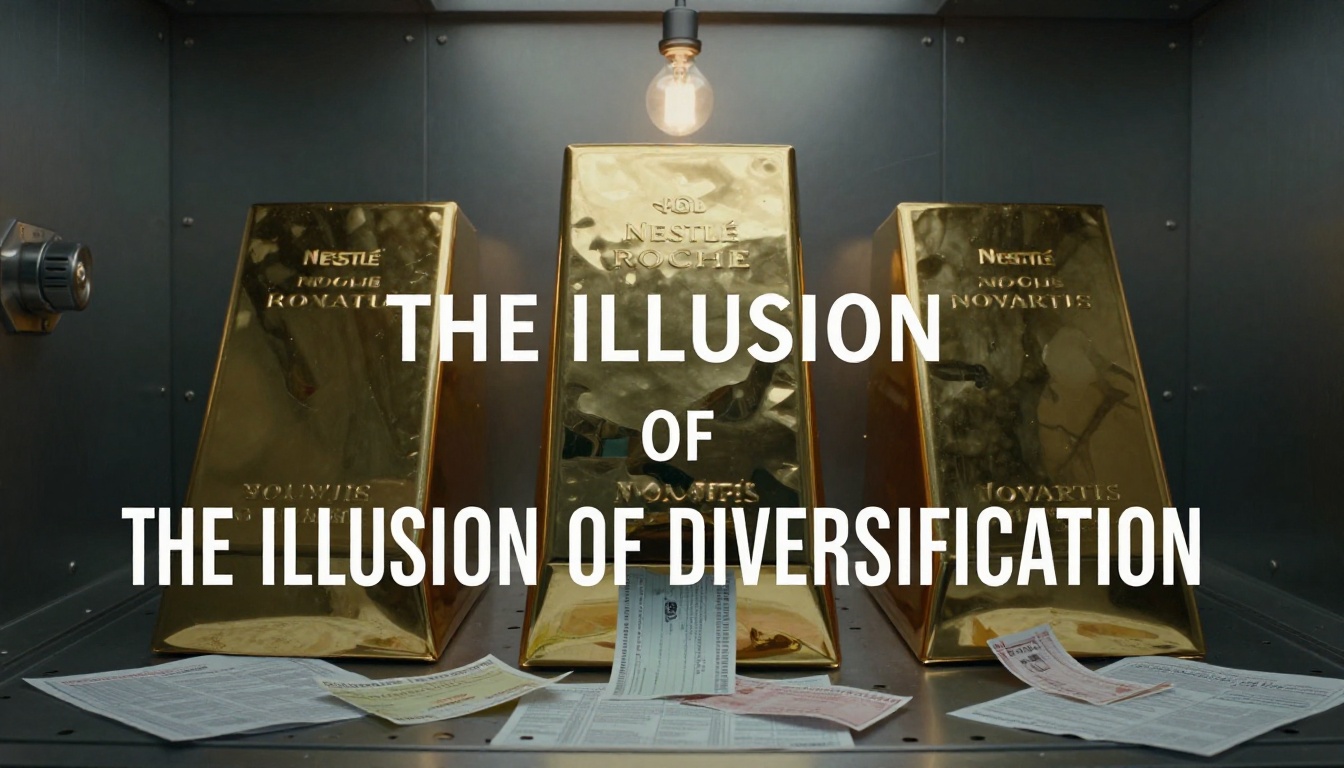
The CHDVD ETF looks irresistible on paper: a Swiss-franc denominated fund packed with dividend aristocrats, delivering steady income from the world’s most stable companies. For Swiss investors already eyeing their domestic market, it screams logic. Why not get paid while you overweight the home team?
That question dominates discussions among Swiss investors evaluating their home bias. Many point to CHDVD’s apparent outperformance against broader Swiss indices like SPICHA or SMICHA over the past decade. The numbers seem to validate the strategy, until you factor in the Swiss tax code, which transforms those appealing dividends into a drag on returns that few calculators capture accurately.
The Dividend Tax Trap Swiss Investors Love to Ignore
Switzerland treats capital gains from private investments as tax-free, a massive advantage over most countries. Dividends, however, face full income taxation. This distinction creates a structural disadvantage for high-yield products like CHDVD.
Every franc distributed gets taxed at your marginal rate, which can climb past 40% in high-tax cantons. The ETF’s 3-4% dividend yield suddenly becomes a 1.5-2% post-tax return before you’ve paid any management fees. Accumulating ETFs like SMICHA aren’t immune either, Swiss tax authorities tax “virtual dividends” (notionelle Dividenden) through the ICTAX system. But since these funds distribute less, the tax burden remains smaller.
Many investors argue they can simply sell shares periodically to create “synthetic dividends” with zero tax drag. This works in theory, but requires discipline and ignores behavioral reality, most people hesitate to sell principal, even when mathematically sound. The psychological comfort of cash flowing into your account has real value, but you pay dearly for it in Switzerland.
The dividend tax implications of Ireland vs US ETFs for Swiss investors reveal similar mechanics: international products often optimize for tax-free capital gains, while Swiss investors using CHDVD voluntarily step into a tax minefield for income they could replicate more efficiently.
When Three Stocks Dominate Your “Diversified” ETF
The concentration risk in CHDVD borders on absurd: Nestlé, Roche, and Novartis represent roughly 45% of the fund’s holdings. If one of these giants stumbles, say, Novartis faces a drug pricing scandal or Roche’s pipeline disappoints, your “diversified” Swiss allocation craters.
Defenders argue this mirrors the broader Swiss market. If Novartis collapses, they claim, the entire SMI suffers anyway. This logic contains a kernel of truth but misses nuance. Broader ETFs like SPICHA spread exposure across mid-caps and smaller Swiss companies that might actually benefit from large-cap weakness. CHDVD’s dividend filter systematically excludes these alternatives, creating a feedback loop where your Swiss allocation becomes a bet on three pharmaceutical and consumer goods conglomerates.
This concentration compounds the Swiss home market bias and concentration risk in domestic equities. Many Swiss investors already carry heavy domestic exposure through their second pillar pension (BVG/LPP) and sometimes third pillar (Säule 3a) products. Adding CHDVD layers risk upon risk, all correlated to the same economic and currency factors.
The Home Bias Justification Falls Apart Under Scrutiny
Recent market analysis from La Financière de l’Echiquier positions Switzerland as a “quality and defensive market” that could benefit from global uncertainty. The Swiss franc’s stability and corporate governance standards make overweighting Switzerland feel prudent.
But quality comes at a price. Swiss equities trade at persistent premiums to global markets. By choosing CHDVD over a global tracker like VT, you pay more for every franc of earnings while sacrificing geographic diversification. You’re not just betting on Switzerland, you’re betting Swiss companies will outperform enough to offset your tax penalty and concentration risk.
The currency considerations and home bias in non-US global ETFs for Swiss investors demonstrate how currency effects often overwhelm stock selection. The CHF strength that hurt Swiss exporters in 2025 could reverse, but you’re already exposed through your salary, property, and pension. Does your investment portfolio need to triple down?
Performance Numbers Lie (Until Tax Day)
CHDVD’s pre-tax outperformance against SMICHA and SPICHA over the past decade tempts many investors. The data shows higher total returns and better risk-adjusted metrics, before taxes.
Run the numbers post-tax, and the story shifts. Assume CHDVD returns 8% annually with a 3.5% dividend yield taxed at 35%. Your effective return drops to 6.78%. Meanwhile, SMICHA returns 7.5% with a 2% dividend yield taxed at the same rate, delivering 6.85% after tax. The gap narrows or reverses depending on your marginal rate and canton.
More importantly, past performance during a bull market for defensive stocks may not persist. The decade saw unprecedented monetary stimulus that favored quality dividend payers. As interest rates normalize and growth stocks regain favor, CHDVD’s strategy could lag. You’re essentially performance-chasing with a tax-inefficient vehicle.
The Behavioral Economics of Dividend Addiction
Some investors willingly accept the tax hit for psychological benefits. They value the tangible income stream that reminds them their capital works for them. One common perspective suggests spending dividends on occasional luxuries makes saving feel real, preventing the “monopoly money” effect of untouched portfolios.
This argument has merit, if you actually spend the dividends. Too many investors reinvest them manually, paying tax for a ritual they could automate more efficiently through accumulating ETFs. The Steueramt (Tax Office) doesn’t care why you chose a distributing fund, they simply add the income to your Steuererklärung (tax declaration) and demand payment.
If you need income, consider whether selling small chunks of a broad, tax-efficient ETF might serve you better. The math works, even if it feels counterintuitive. Handling dividend payouts from global ETFs like VT in a Swiss portfolio shows automation strategies that minimize tax drag while providing cash flow.
Smarter Ways to Satisfy Your Swiss Exposure Itch
If you must overweight Switzerland, consider these alternatives:
SMICHA offers broader exposure with lower dividend yield, reducing tax drag while maintaining Swiss market correlation. It won’t satisfy income cravings but builds wealth more efficiently.
Manual stock picking lets you control concentration. Buy Nestlé directly if you believe in its prospects, but don’t let a dividend filter force you into unwanted bets on the entire Swiss pharma sector.
Sector rotation through global ETFs achieves similar goals. Overweight global healthcare or consumer staples instead of limiting yourself to Swiss names. You get the same defensive characteristics without geographic concentration.
Alternative assets can provide income more tax-efficiently. Diversification beyond global cap-weighted ETFs in Swiss portfolios explores managed futures, commodities, and REITs that offer different risk-return profiles.
The Verdict: A Solution Searching for a Problem
CHDVD solves a problem most Swiss investors don’t have: how to generate high dividend income domestically while paying maximum tax. For the typical investor seeking Swiss exposure, it layers concentration risk onto home bias, then compounds the error with a tax structure that erodes returns.
The fund makes sense only in specific scenarios: you’re a retiree in a low-tax canton who spends every franc of dividend income, or you have a philosophical commitment to Swiss dividend aristocrats that overrides mathematical optimization. For everyone else, it’s a costly emotional comfort.
Your Swiss exposure through second pillar and global ETFs already provides ample home bias. Adding CHDVD doesn’t diversify, it concentrates. And in Switzerland, concentration in dividend payers means concentration in tax liability.
Before clicking buy, calculate your true post-tax return. Then ask whether you’d still choose CHDVD if it meant writing a smaller check to the Steueramt every year. Most investors find their conviction wavers when they see the actual cost of those comforting quarterly payments.