That 0.14 percentage point jump from 1.49% to 1.63% for a 10-year fixed mortgage in just two months isn’t just a rounding error, it’s a signal flare in a market that’s been sleepwalking through historically low rates. For a CHF 800,000 mortgage, that’s an extra CHF 1,120 per year, or roughly the cost of your annual Halbtax card plus a few weekend trips to the mountains. The question gripping Zurich’s property-hungry buyers and refinancing homeowners across Switzerland is whether this is the start of a sustained climb or a temporary blip before rates resume their downward shuffle.
The Mechanics Behind the Sudden Jump
Swiss fixed mortgage rates don’t move on SNB whims alone. They shadow Swiss government bond yields with the devotion of a Bernese Mountain Dog following its owner. Those bond yields have climbed roughly 0.1% over the past two months, and mortgage rates have dutifully tagged along. The driver? Macro expectations, inflation jitters, and global rate volatility that seeps into the CHF capital markets despite Switzerland’s island-like stability.
A recent analysis from Watson confirms the trend: publicly listed reference rates for 10-year fixed mortgages now average 1.74%, up 0.11 points since January. Meanwhile, Houzy’s mortgage tracker shows rates starting at 1.39% for the most creditworthy borrowers, a spread that reveals how individual risk margins can mask broader market movements. The 1.63% figure isn’t an outlier, it’s the new middle ground for buyers with solid but not pristine credit profiles.
Why the SNB’s 0% Decision Changes Nothing
Here’s where conventional wisdom collapses. The SNB held its policy rate at 0.0% on December 12, yet fixed mortgage rates rose anyway. Fredy Hasenmaile, Raiffeisen’s chief economist, explains why: the market had already priced in this decision months ago. In fact, rate markets aren’t forecasting any SNB moves, up or down, for at least a year.

The SNB’s stance matters enormously for SARON mortgages, which float with the policy rate. But for fixed rates, it’s background noise. What counts is the term structure of Swiss franc interest rates, which has steepened slightly as markets price in a tentative European recovery later in 2026. Daniel Hügli, senior economist at Cash.ch, points out that some experts still see a 25 basis point cut to negative territory in the first half of 2026 if the economy sours, a scenario that would make today’s fixed rates look expensive in hindsight.
The SARON vs. Fixed Cage Match
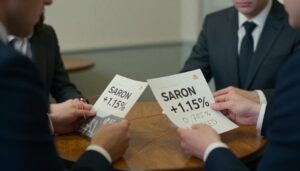
The Reddit finance crowd has been hammering this debate for months, and their lived experience is telling. One buyer who locked in a 10-year fixed at 1.49% in October is now facing 1.63% for the same product. Another homeowner floats on SARON at 0.80% total (SARON + bank margin), having ridden the rate down from last year’s peaks.
The math is brutal: at current levels, SARON saves you about CHF 6,640 annually on that CHF 800,000 mortgage. But that saving comes with a psychological tax. As one borrower put it, “The peace of mind from not having to worry about rates is worth losing 0.5% or so.” This sentiment echoes across countless refinancing discussions, Swiss homeowners will pay a premium for predictability, even when the odds favor floating rates over the long term.
The risk isn’t just higher payments. It’s the Vorfälligkeitsentschädigung, the early repayment penalty that can lock you into a fixed rate like a debtor’s prison. Sell your property before the term ends, and you’ll owe the bank the present value of the interest they lose. The only escape is finding a buyer willing to assume your mortgage at your original rate, a rare feat in a rising-rate environment.
What the 1.63% Signal Means for 2026
Is this the new normal? The data suggests a qualified yes. Rates have likely bottomed out. The 10-year Swiss government bond yield, the ultimate anchor, has been creeping up from negative territory. Even if the SNB cuts to -0.25% next year, long-term rates might not follow. Thomas Rühl of Schwyzer Kantonalbank warns that deflation risks aren’t off the table, but his baseline scenario sees financing costs stabilizing across all durations.
The real driver is the European recovery narrative. If the EU rebounds, Swiss capital market rates will rise regardless of SNB policy. Philipp Merkt, CIO at PostFinance, argues the pressure on the SNB to cut further is currently too low, meaning the tailwind that pushed fixed rates to record lows has dissipated.
The Refinancing Dilemma: Act or Wait?
For the 40% of Swiss mortgages up for renewal in 2026, the decision tree is painful:
Lock in 10 years at 1.63% and you get certainty at a rate that’s still historically low, barely above inflation. You’re betting that rates will rise further or that you can’t stomach volatility.
Float on SARON at ~0.80% and you save heavily upfront, betting that rates stay low or that you can’t absorb a 2-3% SARON if inflation returns. You also retain flexibility to refinance without penalty.
Split the difference with a 3- or 5-year fixed, a strategy gaining traction among buyers who want some protection but don’t trust long-term forecasts. One borrower recently closed a 5-year fixed at 1.06%, a full 0.57% below the 10-year rate, suggesting the market sees near-term stability but longer-term risk.
The Verdict: A New Floor, Not a New Ceiling
1.63% isn’t the new normal in the sense that rates will keep climbing steadily. It’s the new floor, the bottom of the trading range has shifted up. The days of 1.2% 10-year fixes are likely gone unless Europe plunges into crisis. But 1.63% also isn’t a ceiling, a confirmed European recovery could push rates toward 2% by late 2026.
For buyers in Zurich’s brutal property market, where the average apartment costs CHF 1.2 million, this means recalibrating budgets. That 0.14% jump adds CHF 1,680 to annual interest costs, enough to make the difference between affording the 20% down payment or waiting another year to save.
The smart money is splitting strategies: take a shorter fixed term if you expect to move within 5-7 years, float on SARON if you have cash flow flexibility, and only lock in 10 years if you’re settling for the long haul and value sleep more than spreadsheets. The Swiss mortgage market isn’t broken, it’s just waking up from a beautiful dream.