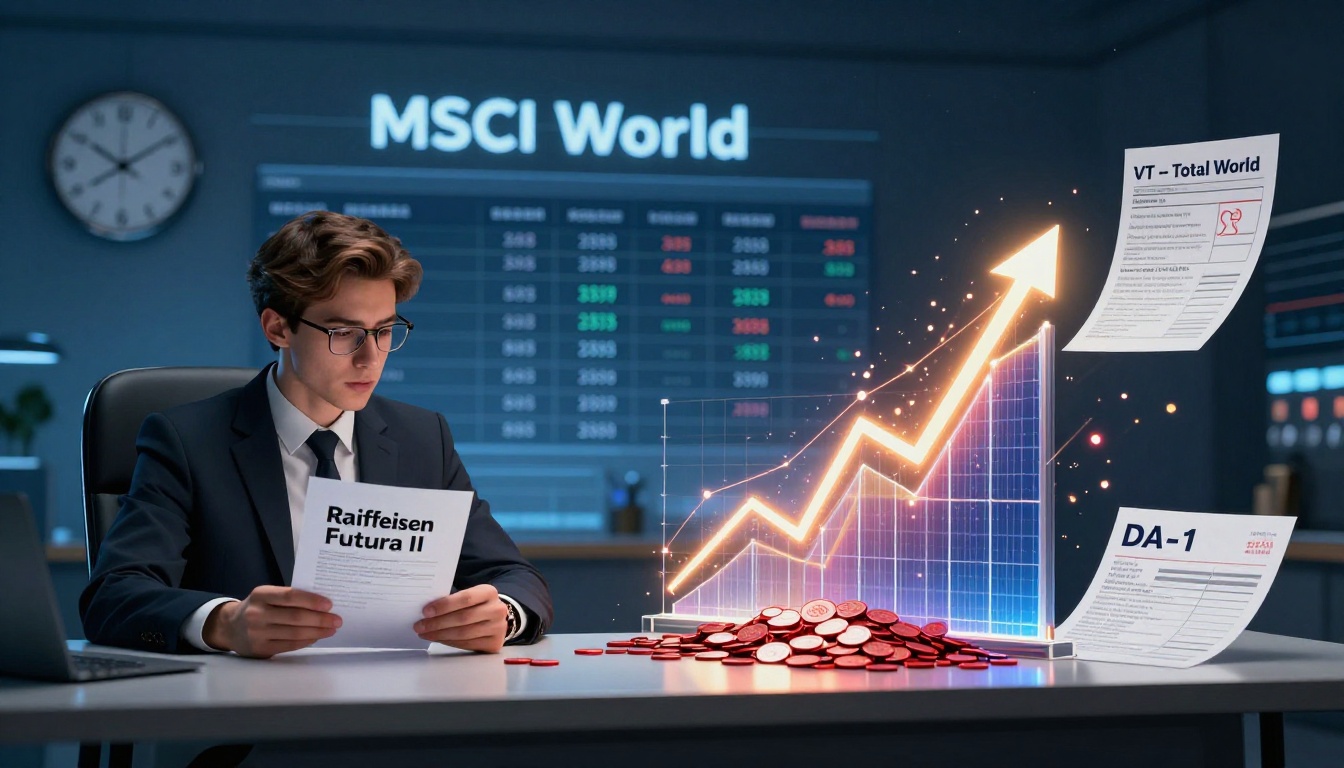
Young Professional’s Investment Dilemma: Why Your Raiffeisen Fund Is Quietly Bleeding Money
You’re 28, earning CHF 75k, and sitting on CHF 39k in cash that could be working harder. You’ve done the responsible thing, maxing out your Säule 3a (Third Pillar) and building a safety cushion. But now you’re staring at your Raiffeisen Fondsspardepot (fund savings account) and wondering if the Futura II fund is really the best home for your money. The short answer: it’s probably costing you six figures in lost returns.

The Real Cost of "Playing It Safe" at Raiffeisen
Let’s dissect what you actually own in that CHF 18k Raiffeisen position. The Futura II – Systematic Invest Growth B fund sounds sophisticated, but the name obscures a simple truth: you’re likely paying 1.5-2% in total annual costs when you factor in management fees, transaction costs, and entry loads. For context, that’s 15-20 times more expensive than a basic MSCI World ETF.
The math is brutal. On CHF 18k, you’re bleeding CHF 270-360 annually in fees alone. Over 30 years, assuming 7% market returns, that fee difference compounds to roughly CHF 30k-40k in lost wealth. And that’s before we even address your Säule 3a allocation.
Your 3a Portfolio Is Stuck in 1995
You mentioned your frankly 3a account holds 45% stocks and 55% obligations (bonds). At 28, this allocation makes zero sense. You have a 35-40 year investment horizon before retirement, and bonds are currently offering negative real returns after inflation. The Swiss pension system was designed for a different era, one where bonds yielded 4-5% and life expectancy stopped at 75.
Many international residents report frustration with these conservative default allocations. The prevailing sentiment among financially literate Swiss investors is that anyone under 35 should be 100% in equities within their 3a. The tax advantage of the 3a wrapper is too valuable to waste on low-yielding fixed income. You’re essentially getting a tax deduction for owning assets that guarantee you’ll lose purchasing power.
The VT vs. MSCI World Debate: A Swiss Tax Twist
Your instinct to invest CHF 30k in an MSCI World ETF at Saxo Bank is directionally correct, but there’s a crucial Swiss-specific optimization you’re missing. The comment about VT (Vanguard Total World Stock ETF) isn’t just internet chatter, it reflects a real tax advantage for Swiss investors.
VT allows you to reclaim the 15% US withholding tax on dividends through the DA-1 form, something many Irish-domiciled MSCI World ETFs cannot offer. This reclaim adds approximately 0.20-0.30% to your annual returns. Over decades, that compounds significantly.
However, VT comes with its own complication: US estate tax risk. If you hold more than $60k in US assets and meet an untimely end, your heirs face a complex US tax situation. For most young Swiss investors, this is a manageable risk, but it’s not zero. The simpler path is an Irish-domiciled MSCI World ETF like iShares Core MSCI World UCITS ETF (IWDA), which avoids US estate tax issues entirely.
prioritizing investment options in Switzerland’s pension system
Why Saxo Bank Is Fine, But Not Optimal
Saxo Bank has a good reputation and solid platform, but you’re still paying currency conversion fees and potentially higher transaction costs than necessary. Interactive Brokers (IBKR) remains the gold standard for cost-conscious Swiss investors, offering interbank exchange rates and the lowest margin rates. The difference seems small, maybe 0.1% per transaction, but on CHF 30k plus monthly CHF 1.2k contributions, it adds up to thousands over your investing lifetime.
The “don’t invest with your bank” advice exists for a reason. Raiffeisen, UBS, Credit Suisse, their business model relies on selling you expensive, actively managed products. They’ll never recommend a CHF 20/year ETF because it generates no profit for them.
The Accumulating vs. Distributing ETF Question
Someone suggested WEBN, an accumulating ETF. For Swiss investors, this is generally smart. Switzerland doesn’t tax unrealized capital gains, and accumulating ETFs automatically reinvest dividends, compounding your returns without triggering taxable events. You want to defer taxes as long as possible, making accumulating ETFs superior to distributing ones in most cases.
The exception: if you need the dividend income to live on, which clearly doesn’t apply to you. Stick with accumulating.
Reconstructing Your Strategy: A Concrete Plan
Here’s how to fix your portfolio:
- Liquidate the Raiffeisen fund. Yes, there might be exit fees. Pay them. The long-term savings dwarf any short-term cost.
- Consolidate the CHF 39k cash and CHF 18k fund proceeds into one position. That’s CHF 57k ready to deploy.
- Open an IBKR account. The learning curve is steeper than Saxo, but the cost savings are worth it. If you must stay with Saxo, accept the slightly higher fees as the price of convenience.
- Deploy the CHF 57k in two tranches: CHF 40k into IWDA (MSCI World) and CHF 17k into an MSCI Emerging Markets IMI ETF to get true global exposure. This gives you roughly 90% developed markets, 10% emerging markets, appropriate for your age.
- Switch your monthly CHF 1.2k investment to 100% IWDA. Automate this through your broker’s ETF Sparplan (ETF savings plan) function.
- Within your frankly 3a, switch to 100% equity. Most 3a providers offer a “100% stocks” option. If frankly doesn’t, consider moving to finpension or VIAC, both of which offer lower costs and better equity options.
100% stock ETF strategies like VT gaining traction in Switzerland
The Psychological Trap You’re Avoiding
Your plan to put CHF 9k back into the Raiffeisen fund reveals a common cognitive bias: the sunk cost fallacy. You feel invested in the fund, so you want to keep some money there to justify the original decision. This is how expensive financial products survive, by exploiting investor psychology.
The data is clear: over 80% of actively managed funds underperform their benchmark over 10 years, and the 20% that outperform rarely repeat their success. You’re not paying for performance, you’re paying for the illusion of expertise.
Tax Optimization: The Missing Piece
You haven’t mentioned your canton of residence, which matters for tax optimization. Some cantons offer better deductions for 3a contributions than others. Zurich, for example, is relatively stingy, while Vaud and Geneva offer more generous treatment.
More importantly, consider your future tax situation. If you plan to leave Switzerland before retirement, your 3a becomes less attractive because you’ll pay withholding tax (Quellensteuer) on withdrawal without getting the full benefit of the tax deferral. In that scenario, you might prioritize taxable accounts with ETFs over additional 3a contributions beyond the minimum needed for the tax deduction.
US estate tax risks for Swiss investors holding VT ETF
The Bottom Line: Simplicity Beats Complexity
Your original plan wasn’t terrible, it just wasn’t optimal. The beauty of the ETF approach is its simplicity: one or two funds, low costs, global diversification, and no active managers taking a slice of your returns.
The Swiss financial system profits from complexity. Banks, insurance companies, and pension funds create elaborate products with layers of fees because simple ETFs would put them out of business. Your job as an investor is to see through this complexity and choose the mathematically superior option.
At 28, your biggest advantage is time. Every franc you save in fees today compounds for decades. Every percentage point of extra return doubles your wealth twice as fast. The difference between a 2% fee fund and a 0.2% fee ETF isn’t 1.8%, it’s the difference between retiring at 60 and working until 67.
savings rate and wealth-building challenges for Swiss professionals
Final Action Steps
- This week: Request liquidation forms for your Raiffeisen fund. Calculate exact exit costs.
- Next week: Open an IBKR account and initiate the transfer. Set up your ETF Sparplan (ETF savings plan) for monthly CHF 1.2k contributions.
- This month: Switch your frankly 3a to 100% equities. If impossible, initiate a transfer to finpension or VIAC.
- Ongoing: Never own an actively managed fund again. Your future self will thank you with actual numbers in their bank account, not just sophisticated-sounding fund names.
The controversy in Swiss investing isn’t between ETFs and funds, it’s between evidence-based decisions and marketing-driven ones. You’ve already taken the first step by asking the question. Now take the second by acting on the answer.
avoiding home bias by excluding Swiss stocks in 3a portfolios