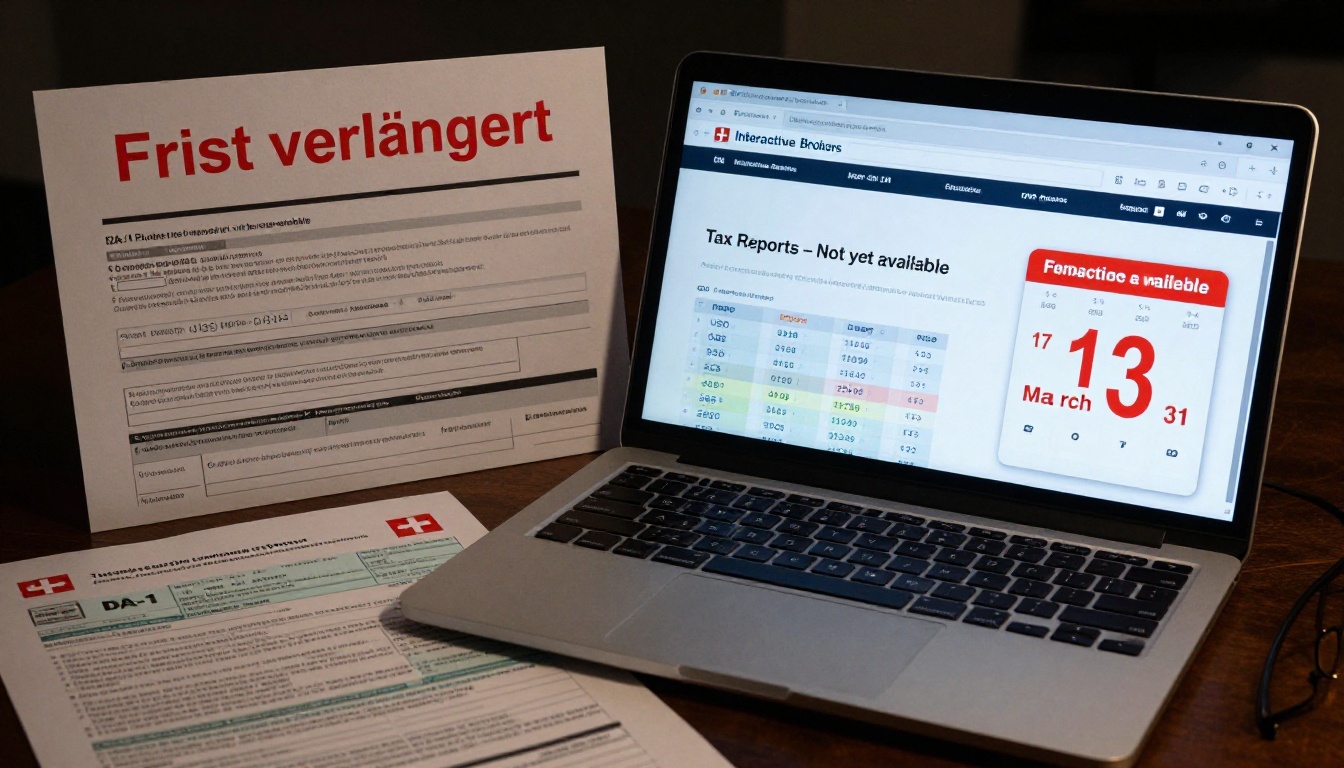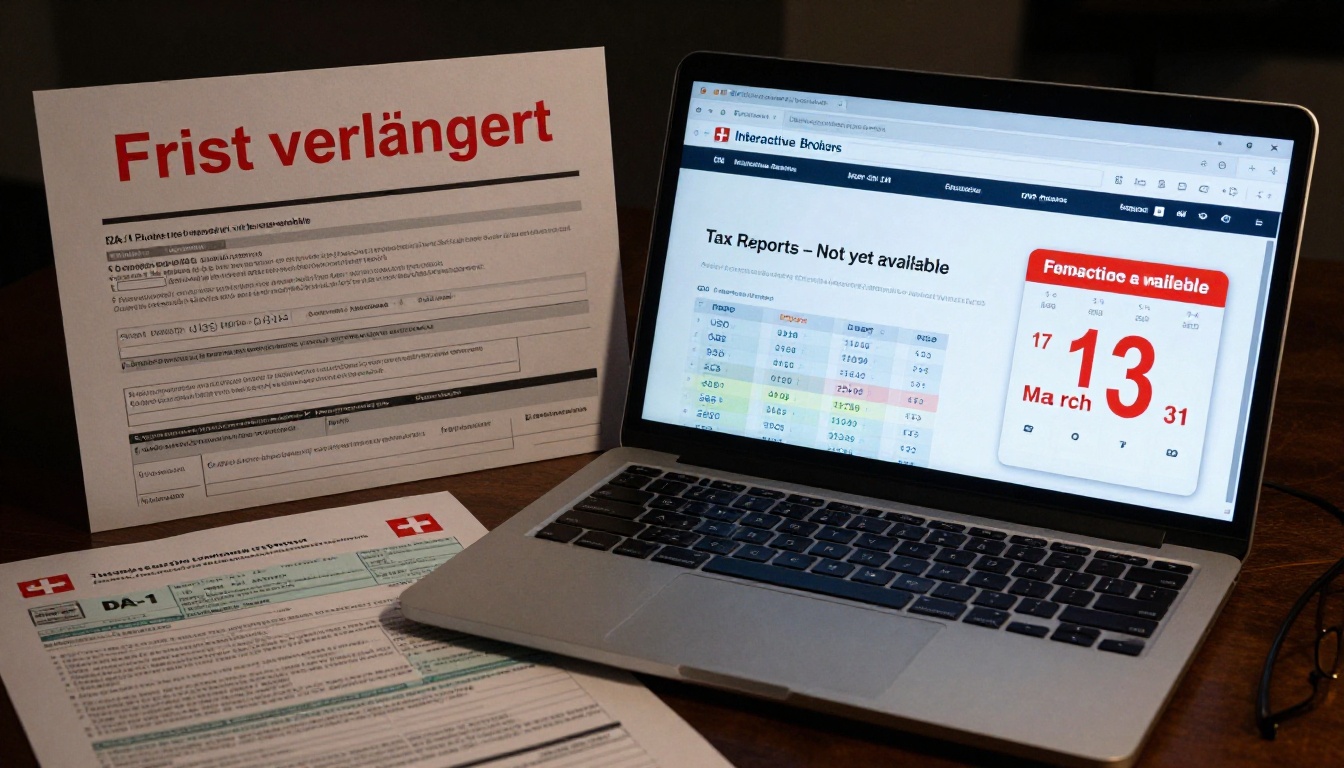
Swiss tax season brings a special kind of dread for Interactive Brokers users. You log into the portal, click “Tax Reports”, and get hit with the same message: “Not yet available.” Meanwhile, your Steuererklärung (tax declaration) deadline creeps closer. This isn’t a glitch, it’s the new normal for foreign brokerage clients in Switzerland, and it exposes a compliance gap that could cost you.
The Interactive Brokers Reporting Gap
Interactive Brokers typically releases its annual tax reports around mid-February. For 2025 data, expect availability around February 17th, according to platform documentation. This creates a timing mismatch: most cantonal tax deadlines fall between March and May, leaving you a narrow window to file. Worse, IBKR’s reports are designed for US IRS requirements, not Swiss tax law.
Many Swiss investors assume they can simply attach IBKR’s PDF and call it a day. The Steueramt (Tax Office) doesn’t see it that way. Swiss tax authorities require specific formatting, currency conversion to CHF, and inclusion in both wealth and income tax calculations. The IBKR report is a starting point, not a finished product.
Swiss Tax Treatment: What Actually Matters
Switzerland’s tax system treats foreign brokerage accounts as Fremdwährungskonten (foreign currency accounts). This triggers two separate tax events:
1. Wealth Tax (Vermögenssteuer)
Every franc in your IBKR account counts toward your worldwide wealth. You must declare the total portfolio value in CHF as of December 31st. Use the official SBB (Swiss Federal Tax Administration) exchange rates, don’t rely on IBKR’s conversion. The difference can shift your tax bracket.
2. Income Tax on Dividends and Interest
Switzerland taxes investment income at your marginal rate. US dividends face a 15% Quellensteuer (withholding tax) under the Swiss-US double taxation agreement, which you can reclaim using form DA-1. Many investors miss this reclaim, effectively paying tax twice.
Capital gains remain tax-free for private investors, but this exemption has a razor-thin edge. If you trade frequently, use options, or derive significant income from trading, the tax office may classify you as a professional securities dealer. Suddenly, your capital gains face income tax at full rates, a financial gut punch.
The FIFO Currency Conversion Trap
The research reveals a critical detail: German tax authorities now mandate FIFO (First-In-First-Out) for currency transactions. While Swiss law doesn’t explicitly require FIFO for securities, the Steueramt increasingly expects this methodology for calculating cost basis, especially for foreign currency accounts.
Here’s the trap: You buy VT (Vanguard Total World Stock ETF) in USD at different times throughout the year. When you sell, you must track which USD purchase you’re liquidating to determine the CHF cost basis. IBKR’s reports don’t do this conversion for you. A CHF 5,000 gain can become a CHF 8,000 taxable event if you use the wrong exchange rate timing.
Three Account Types, Three Compliance Paths
German tax law (BMF letters from 2022 and 2025) categorizes foreign currency accounts into three types, Swiss auditors are adopting this framework for Swiss filings:
- Verzinsliche Fremdwährungskonten (Interest-bearing accounts): Savings accounts, money market funds. All currency gains taxed as income, no one-year speculation period.
- Unverzinsliche Fremdwährungskonten (Non-interest-bearing): Pure brokerage accounts for securities. Currency gains only taxable if bought and sold within one year.
- Zahlungsverkehrskonten (Payment transaction accounts): Accounts used primarily for transfers, not investment. Mixed treatment.
Most IBKR accounts fall into category 2, but if you hold cash balances earning interest, you may trigger category 1 rules. This distinction determines whether your currency conversion gains face immediate taxation or the one-year speculation period.
Practical Steps for 2025 Filing
Step 1: Generate the Right Reports
In IBKR, go to Reports > Tax > Custom Statements. Select:
– Full year 2025
– All sections (trades, dividends, interest, FX conversions)
– PDF format
Print to PDF and attach to your Steuererklärung. But also export the raw data to Excel, you’ll need it for CHF conversions.
Step 2: Convert Everything to CHF
Use the SBB’s December 31st exchange rate for wealth declaration. For income, use the rate on the date of each transaction. The Steueramt accepts either daily rates or monthly average rates, but you must be consistent. Mixing methods triggers red flags.
Step 3: Complete DA-1 for US Dividends
List all US-sourced dividends, the 15% withholding tax paid, and calculate your reclaim. The maximum reclaim is the Swiss withholding tax you owe on that income. If you pay no Swiss withholding tax (common for low incomes), you can’t reclaim the full 15%.
Step 4: Document Your Investor Status
If you trade more than five times per month or hold positions for short periods, prepare a statement explaining your investment strategy. Show you’re a long-term investor, not a professional trader. This simple paragraph can save you thousands in reclassification.
Step 5: File a Corrective Declaration if Needed
German tax law changes are retroactive, and Swiss authorities follow similar principles. If you’ve misreported foreign accounts in previous years, file a Berichtigung (correction) before they find it. Voluntary disclosure avoids penalties.
The Professional Trader Trap
Swiss tax law lacks a precise definition of “professional securities dealer”, leaving auditors discretion. Warning signs include:
– Holding periods under 6 months for most positions
– Using leverage or margin regularly
– Options trading beyond simple hedging
– Derivatives trading
– Generating trading income that exceeds your salary
If any apply, consult a Steuerberater (tax advisor) before filing. The difference between private investor and professional status can exceed CHF 20,000 in tax on a CHF 100,000 gain.
Internal Link Integration
For those just starting with Interactive Brokers, the process of starting investing in Switzerland with brokerage accounts like Interactive Brokers covers account setup and initial funding. If you’re following the popular using VT ETFs through foreign brokerages like Interactive Brokers in Switzerland strategy, your reporting is simpler, fewer transactions, less currency conversion complexity.
The tax implications of simple investing strategies for Swiss residents often get complicated by foreign brokerages. Even if you’re investing through Interactive Brokers and handling tax reporting for portfolio gains, the principles remain the same: document everything, convert correctly, and prove your private investor status.
What Not to Do
Don’t wait for IBKR’s report to start preparing. Download monthly statements throughout the year and track CHF conversions in real-time. Don’t rely on IBKR’s tax report as your sole documentation, Swiss auditors want your calculations. And never ignore the wealth declaration section, failing to report foreign accounts is tax evasion, plain and simple.
The Bottom Line
Interactive Brokers tax reporting in Switzerland isn’t about attaching a PDF, it’s about translating foreign data into Swiss tax language. The delayed 2025 reports force you to be proactive. Start now, convert everything to CHF using official rates, and document your investor status. The Steueramt won’t accept “IBKR wasn’t ready” as an excuse, but they will accept a well-prepared, transparent declaration that shows you understand the rules.
The system rewards the organized and punishes the passive. Your move.