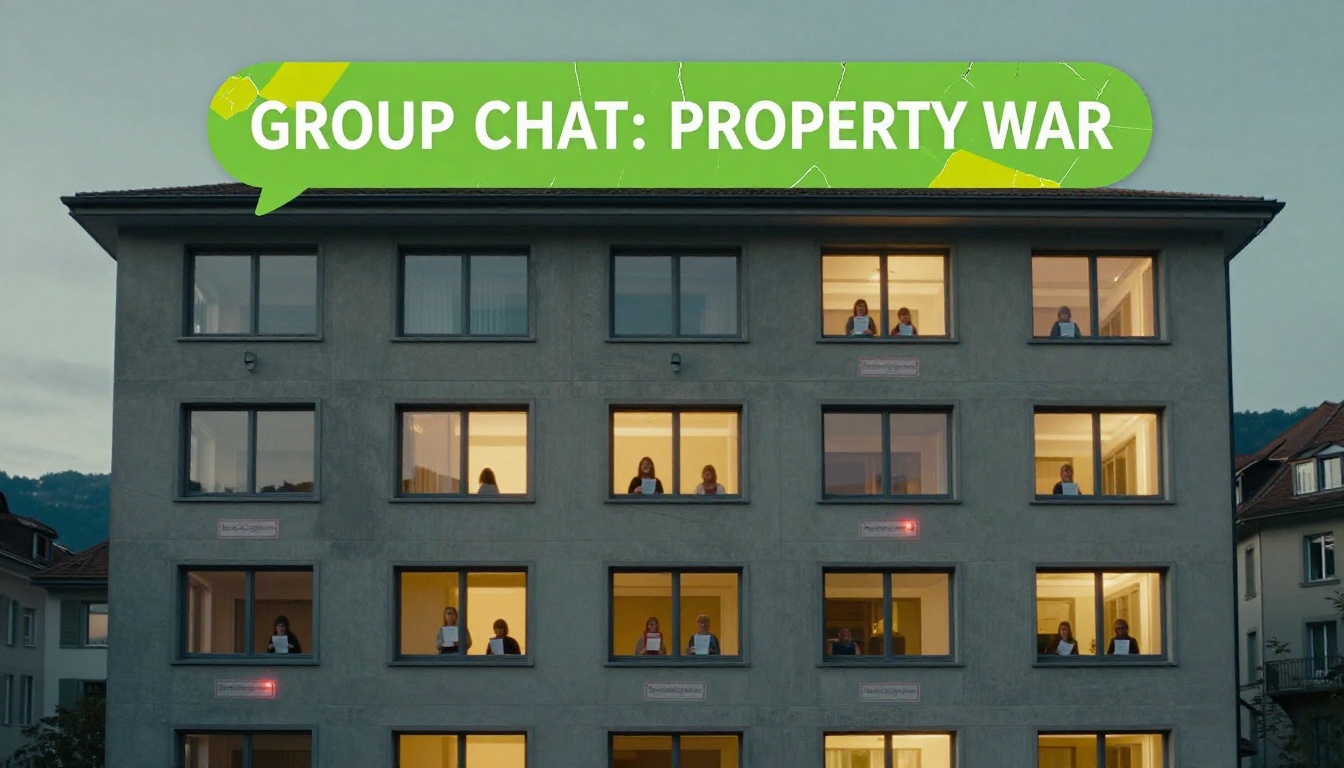
You’ve been hunting for a 4.5-room apartment in Bern for two years. Your budget of CHF 1.8 million is theoretically sufficient, but you’ve viewed exactly five properties and made zero offers. Meanwhile, attractive multi-unit buildings with four to eight apartments sit on the market, taunting you with possibilities. What if you could team up with others, friends, or even strangers, and create your own Stockwerkeigentümergemeinschaft (floor ownership community)?
This scenario isn’t hypothetical. It’s the reality pushing more Swiss residents toward one of the most controversial property strategies imaginable: buying entire buildings with people they barely know. In a market where renting vs. owning financial comparison in Switzerland has become increasingly complex, the idea of pooling resources seems like a clever workaround. But before you start drafting a group WhatsApp message to potential co-investors, understand that you’re stepping into a legal and emotional minefield that has destroyed friendships and drained bank accounts.
The Brutal Math That Makes Strangers Look Attractive
The Swiss housing market operates with the same reliability as an SBB train, usually impeccable, until construction slows the line. In cities like Bern and Zurich, the problem isn’t just price, it’s supply. When you’ve been searching for 24 months and have only five viewings to show for it, multi-unit buildings start looking like a golden ticket.
Here’s the logic: a building with six apartments might list for CHF 5 million. If you can find five other buyers, each person pays around CHF 833,000 for their unit, well below your CHF 1.8 million ceiling. You get more space, better location, and the satisfaction of cracking the housing code. Sellers, particularly those with inherited properties or developers looking to exit, sometimes prefer this arrangement because it avoids the hassle of converting the building themselves.
But this math ignores a critical Swiss reality: the Grundstückgewinnsteuer (property gains tax). If you buy the entire building and convert it to Stockwerkeigentum (floor ownership) yourself, selling the units within five years triggers a tax penalty that can reach 60% of your profit. Many newcomers discover this only after signing on the dotted line.
Stockwerkeigentum: The Legal Framework That Binds You Together
Stockwerkeigentum isn’t just a fancy word for co-ownership, it’s a specific legal structure governed by Art. 712a ff. ZGB (Swiss Civil Code). Each buyer owns their apartment as Sonderrecht (individual ownership) while sharing Miteigentum (joint ownership) of common areas like the roof, facade, and stairwell.
The system works through Wertquoten (value quotas), typically expressed in thousandths, which determine:
– Your share of common costs
– Your voting weight in the Eigentümerversammlung (owners’ assembly)
– Your financial liability for major repairs
This sounds orderly until you realize you’re now financially married to strangers. If the roof needs replacing at CHF 200,000 and one co-owner can’t pay their share, you must cover it. If another owner wants to sell to someone whose creditworthiness is questionable, you have limited veto power. The Verwaltung (property management) might handle day-to-day operations, but major decisions require consensus, a tall order when you met your co-owners through an online forum.
The Financing Trap Banks Won’t Explain Clearly
Swiss banks have a special talent: they can tell you no without ever explaining why. When it comes to multi-unit buildings, their reluctance becomes particularly pronounced.
If you attempt to buy the entire building as a Renditeobjekt (income property) with plans to resell individual units, banks apply a brutal calculation: your mortgage payments and Nebenkosten (ancillary costs) cannot exceed 30% of your rental income. But here’s the catch, if you plan to evict tenants to sell units, you have no rental income, making the mortgage “untragbar” (unaffordable) in bank terminology.
One commenter noted that multi-unit purchases require at least 30% equity, making them accessible only to those with substantial existing assets and willingness to leverage. This creates a paradox: the people who can afford to buy buildings outright don’t need co-investors, while those who need co-investors struggle to secure financing.
The Swiss mortgage affordability and bank lending constraints become even more complex when multiple unrelated buyers are involved. Banks must assess each buyer’s creditworthiness separately while evaluating the collective risk, a process so cumbersome that many institutions simply decline.
The Human Factor: Where Deals Go to Die
Finding compatible co-buyers is like organizing a group vacation where everyone must agree on the destination, hotel, and budget, except the vacation lasts decades and costs millions. The challenges multiply exponentially:
- 1. The Selection Problem: You want the attic apartment, your friend wants the garden unit, strangers you recruit online might demand the ground floor with commercial potential. After two years of fruitless searching, you couldn’t compromise on existing properties. What makes you think you’ll agree on a building requiring six simultaneous decisions?
- 2. The Exit Strategy: Life happens. Someone gets a job in Geneva, another divorces, a third faces unexpected medical bills. In a Stockwerkeigentümergemeinschaft, any unit sale affects the entire group. The new buyer must be approved by the bank and accepted by the community. If the market dips and someone needs to sell at a loss, resentment poisons relationships.
- 3. The Decision-Making Gridlock: Renovating the facade? Upgrading the heating system? Painting the front door? Each decision requires a Versammlung (assembly) and specific majorities. With strangers, emotional investment is low, making consensus nearly impossible. Many international residents report that this is among the most challenging adjustments to Swiss property ownership.
The AG/GmbH Alternative: Trading One Problem for Another
Some advisors suggest purchasing through an AG (public limited company) or GmbH (limited liability company) instead of direct Stockwerkeigentum. The logic: if you want out, you simply sell your shares. The company structure simplifies decision-making and limits personal liability.
But this approach triggers another Swiss concern: “If the company goes bankrupt because I did a bad job, they would lose their flats.” Most buyers want direct ownership of their unit, not shares in your potentially mismanaged company. The structure works for pure investment properties but fails when people want to live in the units they’ve purchased.
Platforms like Crowdhouse operate on similar principles, but they function as professional intermediaries with established legal frameworks and risk management, luxuries your ad-hoc group of strangers won’t have.
Why Professionals Have Already Priced Out Your Opportunity
Here’s the uncomfortable truth: when a multi-unit building hits the market, professional investors, developers, and established property companies evaluate it within days. They calculate conversion costs, tax implications, and market values with precision. The price you pay already includes their profit margin.
If you buy a building for CHF 5 million, convert it to Stockwerkeigentum, and sell six units for CHF 1 million each, you’ve made CHF 1 million gross. But after conversion costs (CHF 100,000), property gains tax (CHF 300,000+ if sold within five years), bank interest during the holding period, and marketing expenses, your profit evaporates. Meanwhile, professionals finance at lower rates and execute these conversions routinely.
The investment alternatives to Swiss real estate become starkly attractive when you run the actual numbers. That CHF 1.8 million might generate better returns with less headache in a diversified portfolio.
The Eviction Morality Play and Tenant Protection
Many multi-unit buildings are fully rented. Your plan requires evicting tenants, a process governed by strict Swiss tenant protection laws. You can’t simply terminate leases because you want to sell units. The Mietrecht (tenancy law) requires valid personal use grounds, and “I want to profit from splitting the building” doesn’t qualify.
Even if you legally evict, the process takes months. During that time, you pay mortgage on an empty building while generating zero income, destroying your bank’s required 30% rental income ratio. The moral aspect aside, the financial risk is substantial.
When This Actually Works (And Who Should Attempt It)
Despite the warnings, successful group purchases do occur. They share common characteristics:
- Pre-existing relationships: Family members or decades-long friends with aligned financial goals
- Matched budgets and expectations: Everyone has similar financial capacity and lifestyle requirements
- Professional guidance: Engaging a specialized lawyer and property manager before making offers
- Long-term horizon: No one plans to sell within 10+ years, avoiding the worst tax penalties
- Clear exit agreements: Legally binding prenups for the property, specifying buyout procedures and valuation methods
For the Bern buyer with CHF 1.8 million, the smarter play might be patience. The municipal-level rent vs. buy analysis in Switzerland shows that buying beats renting in 57% of municipalities, but that statistic assumes conventional purchases, not complex group arrangements.
The Swiss Bureaucratic Reality Check
- Grundbuchamt (Land Registry Office): Each unit needs separate registration, requiring surveys, notarized documents, and fees
- Steueramt (Tax Office): Property transfer taxes, potential gains taxes, and ongoing wealth tax calculations
- Bauamt (Building Authority): Conversion permits, compliance with energy regulations, and potential renovation requirements
- Banking compliance: Anti-money laundering checks multiplied by the number of buyers
Final Verdict: A Tool for the Few, Not the Many
Buying property with strangers in Switzerland isn’t inherently impossible, it’s just extraordinarily difficult, risky, and rarely profitable for amateurs. The strategy works for:
– Family syndicates with established trust and shared legal representation
– High-net-worth individuals who can afford the entire building alone if co-buyers flake
– Professional investors with experience in Swiss property law and tax optimization
For the average buyer frustrated by limited supply, the risks outweigh the benefits. You’re better served exploring using pension funds for property down payments in Switzerland or accepting that the Swiss property market, like an SBB train during rush hour, sometimes requires waiting for the next connection rather than forcing your way onto an overcrowded carriage.
The housing shortage won’t resolve through risky co-purchases. It requires systemic solutions: increased construction, streamlined permitting, and perhaps reconsideration of the Eigenmietwert (imputed rental value) tax that distorts ownership incentives. Until then, patience remains the least expensive strategy, emotionally and financially.

A typical Swiss multi-unit building. While the structure looks solid, the ownership arrangement can be anything but.
Bottom line: If after two years you can’t find a single apartment to bid on, adding five strangers to the equation won’t solve your problem, it just gives you five more reasons why deals fall through. Stick to conventional purchases, expand your search radius, or consider that Pillar 3a mortgage-linked savings and financial lock-in risks might be the lesser evil compared to co-owning with someone whose financial stability you learned about through a brief email exchange.