The job offer lands in your inbox: €85,000, up from €60,000. The catch? You’ll need to drive 90 kilometers one way, mostly on the Autobahn (German highway system), adding 180 kilometers to your odometer every single workday. For many German professionals, this isn’t hypothetical, it’s the exact calculation one worker posted when deciding whether to move closer to his partner while keeping a distant job.
At first glance, the math looks seductive. A €25,000 gross increase translates to roughly €10,500 net after German taxes and social contributions. Even after accounting for fuel, that’s still a healthy bump, right? But dig deeper, and the numbers start telling a different story, one where time, vehicle costs, and quality of life quietly erode that raise until you’re working harder for less meaningful gain.
The Gross Illusion: Why Your Raise Shrinks Faster Than You Think
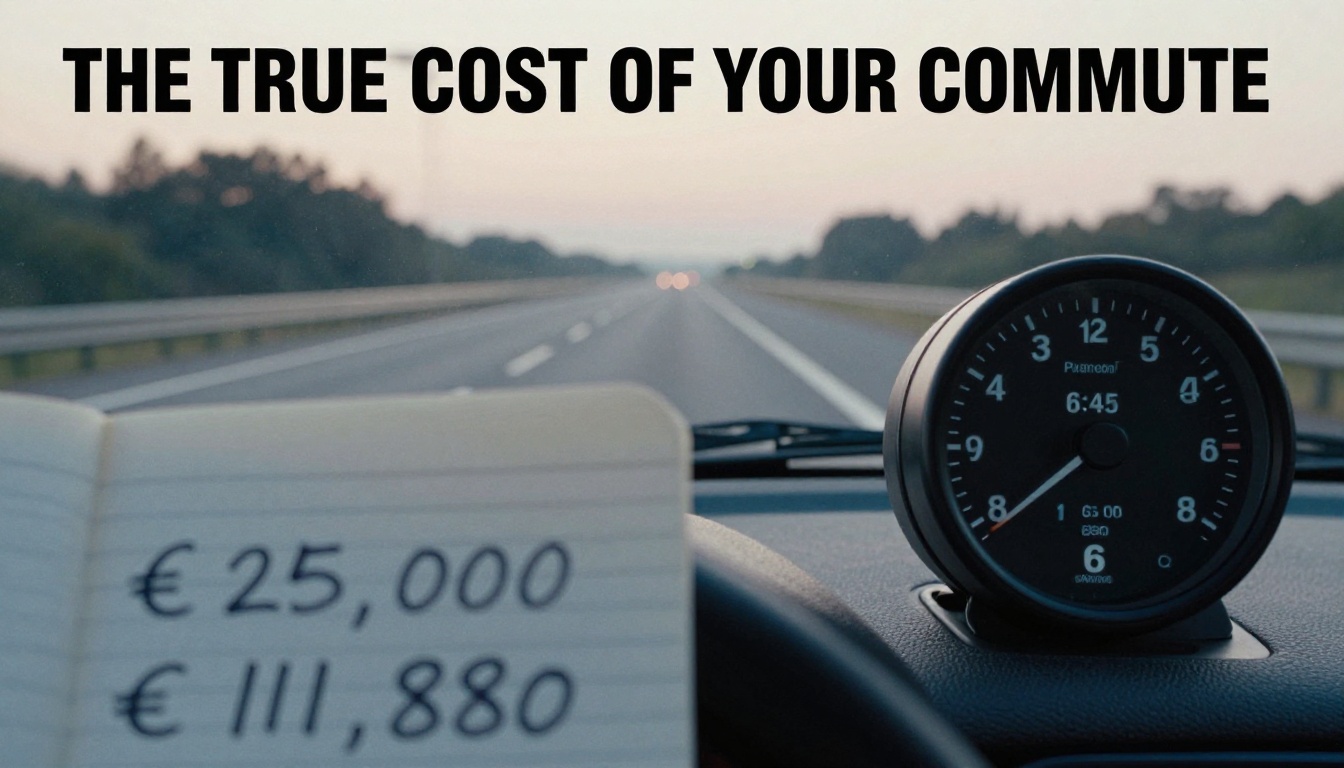
Let’s run the actual numbers. Driving 180km daily with a realistic cost of €0.30 per kilometer (covering fuel, insurance, maintenance, and depreciation) totals €54 per day. Over 220 workdays annually, that’s €11,880 in direct mobility costs. Your €25,000 raise just dropped to €13,120 before taxes.
But here’s where German tax law adds complexity. The Pendlerpauschale (commuter allowance) lets you deduct 38 cents per kilometer from your taxable income starting in 2026. For 90km one way, this creates an annual deduction of 90 × €0.38 × 220 days × 2 = €15,048. Sounds generous, until you realize this only benefits you if your total Werbungskosten (work-related expenses) exceed the €1,320 Arbeitnehmerpauschbetrag (employee lump sum). For high earners in Germany’s progressive tax system, this can mean real savings. For others, the benefit is smaller than it appears.
The real kicker? You’re still fronting the cash. The Pendlerpauschale reduces your tax bill, but it doesn’t deposit money in your account each month. You’ll spend €990 on commuting costs monthly while waiting for a tax refund that might only materialize once a year. That financial gap between actual commuting costs and tax allowances creates a cash flow squeeze many commuters underestimate.
The Time Tax: Converting Minutes into Years of Life
Financial costs are only half the equation. That 45-50 minute drive each way adds 1.5 hours daily to your work commitment. Over a standard 220-day work year, you’re sacrificing 330 hours, equivalent to 41 full workdays spent just sitting in your car.
Scale this across a typical German career of 40 years, and you’ve spent 1.3 years of your life commuting. That’s not just time, it’s opportunity cost. As one commenter bluntly put it: “You’re looking at 10+ hour days. After that, you’re done. And you have the stress of driving 200km every day.”
The value of remote work as an alternative to long commutes becomes clear when you quantify this time. Would you accept a €15,000 pay cut to reclaim 1.3 years of your life? Many German workers are answering yes, especially after experiencing home office during recent years.
The Hidden Depreciation Bomb
German drivers consistently underestimate true vehicle costs by nearly 50%. While you might calculate fuel at €0.12 per kilometer, you’re likely ignoring the hidden and underestimated costs of car ownership: depreciation, tire wear, unexpected repairs, and higher insurance premiums from increased mileage.
Driving 39,600 kilometers annually just for commuting means you’ll hit 200,000km in five years. Your three-year-old VW Golf that’s worth €18,000 today? It’ll plummet to €8,000 with that mileage. That’s €2,000 per year in depreciation alone, money that never appears in monthly budgets but vanishes nonetheless.
Add the psychological cost: Autobahn driving at peak times, even antizyklisch (counter-cyclical, i.e., against rush hour), carries stress. One Reddit user warned: “Until they set up a 10km single-lane construction zone that takes five years to finish.” German infrastructure projects are notorious for exactly this scenario.
The Quality of Life Audit: What Are You Really Buying?
Here’s the uncomfortable question: What does €10,500 net actually purchase you? If you’re moving from €1,300 warm (rent including utilities) in the city to €500 warm in a rural area, you’re saving €800 monthly. But you’re spending €990 on commuting. You’re net negative €190 per month, plus you’ve lost 1.5 hours daily.
The trade-off between higher income and quality of life becomes stark. One German worker shared: “I switched jobs, gave up 10% salary, and got 14km in 20 minutes each way plus a private life. It was worth it.”
Another calculated brutally: Net income minus mobility costs divided by hours of work plus commute time. The result? Only a 7% hourly wage increase despite the €25k raise. For many, that margin doesn’t justify the lifestyle sacrifice.
The German Tax Twist: Pendlerpauschale Details That Matter
Starting 2026, every kilometer counts at 38 cents, eliminating the previous two-tier system that favored long-distance commuters. For our 90km example, this creates substantial deductions. But critical limitations exist:
- Home office days don’t count: If you work from home Tuesdays and Thursdays, you lose those days from your calculation
- The €4,500 cap: Only applies if you use public transport, bike, or carpool. Using your own car? No cap applies, which helps our long-distance case
- Documentation required: You need plausible records of workdays. A simple Excel sheet with dates and locations suffices, but without it, the Finanzamt (Tax Office) can deny your claim
The Pendlerpauschale works best for high earners in Germany’s top tax brackets. If your marginal tax rate is 42%, that €15,048 deduction saves you €6,320 annually. At a 25% rate, you save only €3,762. Your actual benefit depends entirely on your overall income picture.
The Break-Even Framework: Four Questions to Ask
Before accepting that long-distance job, run this analysis:
1. What’s your real hourly rate?
Calculate: (Net salary increase – true commuting costs) ÷ (work hours + commute hours). If the result is less than a 10% improvement, reconsider.
2. Can you sustain the time drain?
Test drive the route for two weeks at actual commute times. A 45-minute drive on Sunday can become 75 minutes on a Tuesday morning. Many German commuters report that reality exceeds Google Maps estimates.
3. What’s your exit strategy?
If you burn out in six months, the transaction costs of switching jobs again eat into any gains. German notice periods (Kündigungsfristen) can lock you in for 3-6 months.
4. Are you counting invisible money?
That €25k raise might push you into a higher tax bracket, increasing your marginal rate. Combined with social security contributions, your net gain might be closer to €9,000 than €10,500.
The Alternative Path: When Saying No Makes Financial Sense
Sometimes the best financial decision is rejecting the raise. Consider:
- Negotiating remote work: Even two home office days weekly cuts commuting costs and time by 40%
- Requesting a company car: If the employer provides a Dienstwagen (company car), you avoid depreciation and maintenance costs entirely
- Delaying the decision: Accept the role but keep your current residence for three months. Test the commute before committing to a move
The policy debate on part-time work and work-life balance in Germany reflects growing recognition that more hours don’t equal better outcomes. A 32-hour week with no commute can provide more disposable income per hour of life invested than a 40-hour week with 180km of driving.
The Verdict: A Calculator, Not a Rule
There’s no universal answer. A 25-year-old single professional might gladly trade time for career acceleration. A 40-year-old with children experiences that 1.5 hours as stolen family time.
Run your numbers honestly. Factor in the impact of tax and social security changes on net income. Test the commute during real conditions. And most importantly: value your time at least as highly as your salary. That €25,000 might cost you more in life than it adds to your bank account.
The German tax system offers tools like the Pendlerpauschale, but they’re bandages on a structural wound. The real question isn’t whether you can afford the commute, it’s whether you can afford to lose those hours of your life.

The job offer lands in your inbox: €85,000, up from €60,000. The catch? You’ll need to drive 90 kilometers one way, mostly on the Autobahn (German highway system), adding 180 kilometers to your odometer every single workday. For many German professionals, this isn’t hypothetical, it’s the exact calculation one worker posted when deciding whether to move closer to his partner while keeping a distant job.
At first glance, the math looks seductive. A €25,000 gross increase translates to roughly €10,500 net after German taxes and social contributions. Even after accounting for fuel, that’s still a healthy bump, right? But dig deeper, and the numbers start telling a different story, one where time, vehicle costs, and quality of life quietly erode that raise until you’re working harder for less meaningful gain.